
Beyond Applause: The ROI of Employee Recognition in Business Performance
Key Takeaways
- Recognition is evolving from an engagement and culture-building practice into a strategic driver of business performance.
- The ROI of employee recognition goes beyond participation and redemption metrics to measure business outcomes such as productivity, talent retention and customer satisfaction.
- BI WORLDWIDE’s New Rules of Engagement research highlights how employees who feel included are 6X more likely to put in maximum effort and 17X more likely to contribute their best ideas.
- An effective employee recognition program balances everyday appreciation (soft-touch) with selective, coveted rewards (hard-touch) to drive engagement and long-term business value.
- Strategic employee recognition reinforces organisational values by celebrating the behaviours that bring them to life, turning the values into everyday culture.
- BI WORLDWIDE’s employee recognition strategy helped a global healthcare tech brand achieve its target of improving free cash flow conversion by 80% in just one year, ahead of the planned 2-3-years timeline.
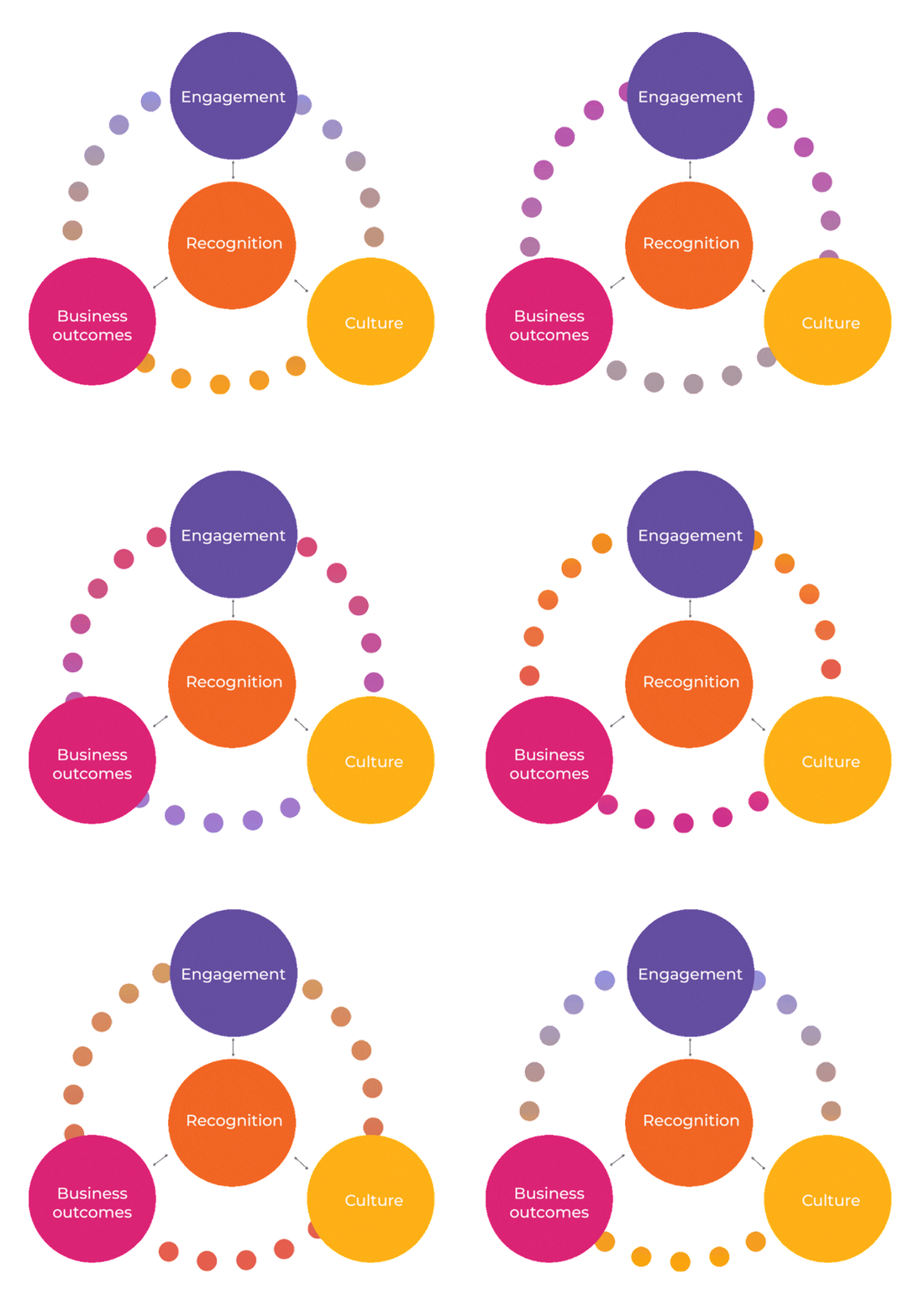
Recognition is evolving. It’s no longer just an engagement or cultural practice – it’s becoming a business strategy. At BI WORLDWIDE, we place employee recognition at the strategic intersection of engagement, culture and business results.
Recognition fuels engagement by making people feel valued. However, engagement alone can ebb and flow over the lifecycle of an employee and an organisation, as they go through successes, changes and challenges. That’s where culture kicks in.
A culture of recognition sustains performance by continuously reinforcing the key behaviours and outcomes that matter to your business. . BI WORLDWIDE’s New Rules of Engagement research backs this up – the more employees you recognise, the stronger your culture of recognition. When ALL employees are recognised, they feel connected to the culture, driving business results and improving the ROI of employee recognition. The research reveals:
Employees who feel included are 6X more likely to put in maximum effort, 17X more likely to say that their work brings out the best ideas.
The message is clear
Recognition is not just central to employee engagement programs, but also to work culture and when executed strategically, to business outcomes.
At SHRM India Annual Conference 2025 – industry’s most niche gathering of experts in Rewards and Recognition (R&R) space – BI WORLDWIDE hosted an exclusive panel discussion to reinforce this takeaway and help HR leaders turn their recognition spend into bottom-line results through strategic employee recognition programs.
Rupak Ray, VP – Customer Success & Strategic Solutions (BI WORLDWIDE India) brilliantly led the session – Beyond Applause: The ROI of Recognition in Business Performance, featuring people-first CHROs and HR leaders from top organisations – Debasis Sarkar, EVP – Global C&B and Enterprise HR Head (HCLTech), Richa Sethi, Global Head – Performance & Talent Management (UST Global) and Subnesh Sharma, Sr. Director – HR Strategy (VVDN Technologies).
Strategic employee recognition: Not just inspiration-driven, but impact-driven
The session spotlighted how Rewards and Recognition (R&R) programs are transforming from an engagement or culture-building initiative to a strategic business growth enabler.
Traditionally, engagement and culture have long been the goalposts for R&R programs. However, when it comes to measuring the impact of R&R programs, HR leaders often end up with transactional metrics like total number of recognitions, volume of redemptions, types of rewards redeemed, etc. No focus is laid on measuring the real business impact through metrics like productivity, talent retention, customer satisfaction and more.
So, it’s time to elevate R&R programs from just a ‘feel-good’ initiative to a data-driven business performance lever that directly impacts the ROI of employee recognition.
Measuring the ROI of employee recognition
The session opened up with a thought-provoking question – How are leading organisations tracking the ROI of employee recognition?
Highlighting how new-age R&R programs are tied to business results, Debasis Sarkar remarked, “Rewards and Recognition (R&R) programs can vary from being soft-touch (instant recognition) to hard-touch (coveted recognition), for catering to a mix of generations in the workforce and driving diverse business KPIs. While the first level outcome of R&R is soft-touch – instant engagement, it often unlocks hard-touch outcomes in the long run like talent retention, productivity, succession planning of leadership and more.”
Debasis substantiated his insight with the instance of HCL’s niche R&R program called – Superchargers League. The program selected top 50 leaders across the organisation, following a rigorous nomination and screening process by business heads, including the CEO. Finally, the 50 leaders were felicitated at a grand awards ceremony, in the presence of directors and senior board members. This hard-touch, strategic employee recognition move was directed towards a precise business outcome – building the next generation of leadership, ready to take up additional responsibilities.
Similarly, Richa Sethi underlined the importance of data-driven Rewards and Recognition (R&R) programs, that empower top organisations to achieve measurable business results. She stated, “What gets measured often turns into a business imperative. Tracking data-driven insights from R&R programs like – change in retention, discretionary efforts by teams, client outcomes and more – can link the programs directly with strategic organisational priorities and improve the ROI of employee recognition.”
The panellists also shared other actionable strategies to elevate the business impact of R&R programs:
- Make recognition humanised and personalised, not just tech-driven, inspiring employees to go the extra mile.
- Build recognition into your talent ecosystem. Make it a key consideration in career advancement and performance reviews, motivating employees to deliver their best.
- R&R shouldn’t be a one-off employee engagement program. Sustain a culture of recognition to drive business outcomes in the long run.
- Change the paradigm of R&R from recognising a select few, to a strategic employee recognition initiative that shapes how your work culture essentially operates.
- R&R shouldn’t be one-size-fits-all. Identify what motivates different employees across your organisational hierarchy to drive desired behaviours. Decoding the right frequency of recognition for every role also contributes to business results.
Elevating business results with values-driven employee recognition programs
The industry experts shared another fascinating insight. Aligning Rewards and Recognition (R&R) programs with core organisational values reinforces positive behaviours across the workforce, unlocking belonging, productivity, retention, brand advocacy and more.
Richa Sethi put it brilliantly, “Every time you celebrate employees living your values, it sets off a ripple effect – reinforcing the very behaviours across the organisation that move your business forward.”
She cited UST’s R&R program called UST Handprint, that incentivised desired value-led behaviours across the board, turning organisational values into everyday culture and impacting the ROI of employee recognition.
The key takeaway? R&R cannot operate in silos; it must be tied to strategic organisation-wide initiatives to amplify impact. Moreover, R&R should be proactive, not reactive in nature, celebrating the right value-led behaviours at every milestone, to inspire meaningful results.
Real-world business impact: Driving financial excellence through recognition
That’s exactly what BI WORLDWIDE did for a global healthcare tech brand.
Business Challenge: The brand wanted to improve its free cash flow conversion by 80% over 2-3 years, so they could reinvest in their business and people. However, many of their 95,000 employees could not even define free cash flow.
Solution: BI WORLDWIDE tapped into the brand’s strong culture of recognition, to build momentum for achieving the desired goal. Recognise – a strategic employee recognition program was designed, as a launchpad for the Free Cash Flow Challenge.
Result: The 80% free cash flow conversion target, set for 2-3 years, was achieved within just one year – clearly demonstrating the ROI of employee recognition.
The bottom line: R&R done right = ROI you can measure
The future of recognition is here: strategic, measurable and results-driven.
Today’s HR leaders need to evolve from culture champions to architects of business strategy – responsible for elevating the ROI of employee recognition.
Frequently Asked Questions
The ROI of employee recognition lies in measurable business gains – from higher retention and productivity to greater belonging, brand advocacy and a sustained culture of recognition – relative to program costs.
Measure soft-touch indicators, such as recognition frequency and participation, alongside hard-touch outcomes, such as retention, productivity and succession readiness. This helps connect recognition with tangible business results and quantify the ROI of employee recognition.
Soft-touch metrics capture the immediate impact of everyday appreciation on engagement. Hard-touch metrics reveal long-term outcomes, such as retention, productivity, and succession planning. Together, they help strengthen an employee recognition strategy by connecting recognition efforts with measurable business outcomes.
A strategic employee recognition program reinforces behaviours aligned with organisational values and business priorities. By recognising contributions that drive outcomes like performance, customer satisfaction and brand advocacy, it embeds values into everyday culture and delivers measurable business results.
Recognition celebrates an employee’s efforts, achievements, or desired behaviours. Rewards provide tangible benefits such as points, gift cards, vouchers, or experiences. An effective employee recognition strategy combines aspirational rewards with meaningful appreciation to reinforce desired behaviours and drive greater impact, rather than relying on either alone.
HR leaders should anchor their employee recognition strategy in business priorities that leadership tracks such as attrition, productivity and free cash flow, rather than treating recognition as a standalone HR initiative. BI WORLDWIDE’s Recognise program helped a global healthcare tech brand achieve its free cash flow conversion target in just one year, ahead of schedule, demonstrating how strategic employee recognition can deliver measurable financial performance.
Employee recognition programs, powered by new-age digital platforms, deliver real-time, personalised experiences at scale. By analysing recognition patterns alongside retention and performance data, organisations can strengthen work culture, while uncovering opportunities to improve engagement and performance.
With fewer spontaneous, in-person interactions, hybrid and remote teams need more opportunities for appreciation. Organisations should focus on making recognition timely and visible for such employees to make them feel valued and connected to business goals.
Treating recognition as a one-off initiative, failing to personalise recognition to what motivates different employees, and measuring transactional metrics like redemption rather than business outcomes can limit a program’s impact. An effective, data-driven employee recognition strategy sustains a culture of appreciation, reinforces desired behaviours and connects recognition with measurable business results.