
Your Result: Organizational Ownership
Your results show that employees are looking to the organization itself for stability, meaning, and well-being. Engagement will grow when you focus on creating fairness, purpose, and opportunities to thrive.
Your snapshot results
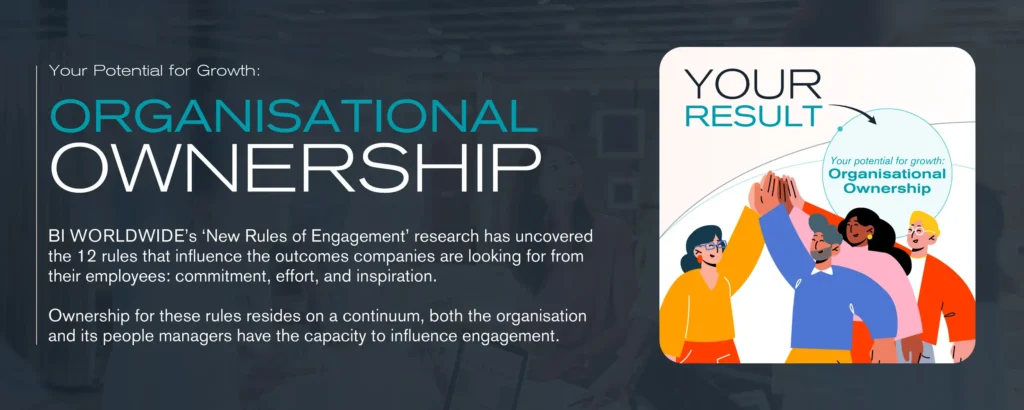
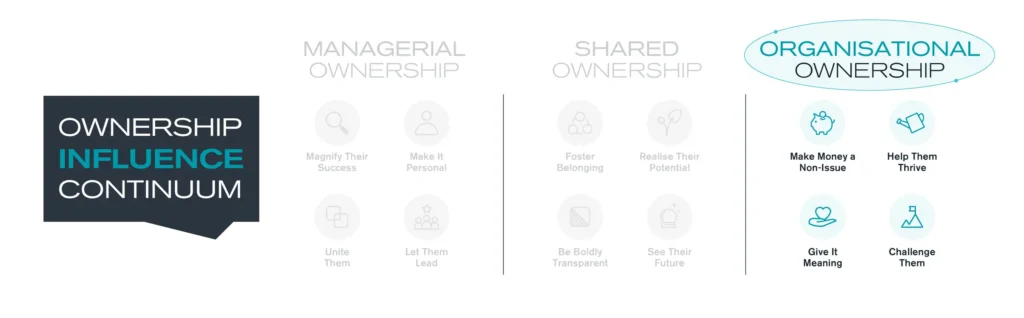
Organizational Ownership refers to the rules in the New Rules of Engagement that can be mostly influenced by the actions of the organization .
Read below for insight into some of the ways in which the organization can impact the overall experience of your employees and to learn more about the New Rules of Engagement.
Why Organizational Ownership matters
There’s a strong link between a healthy workplace culture and employee health. In research conducted by Stanford professor Jeffrey Pfeffer, he cited that those employees who perceive their workplaces as being unfair were about 50% more likely to develop a physician-diagnosed condition.
The pandemic brought this connection into sharp focus, with studies reporting a correlation between employees feeling supported by their employer/manager and an improved sense of well-being.
However, despite the amplified profile and employer efforts, burnout remains a widespread issue. According to a global workplace study by McKinsey in 2022, there’s as much as a 22% gap between employee and employer perceptions of mental health and wellbeing in the organization, suggesting that organizations are still getting it wrong.
The problem, as per a Gallup report, is that burned-out employees are…
- 23% more likely to visit a hospital,
- 63% more likely to take a sick day, and are
- 2.6x as likely to be actively seeking a different job
- Those that stay “typically have 13% lower confidence in their performance and are half as likely to discuss how to approach performance goals with their manager”.
But whilst burnout is on the rise, contrary to what you might expect, burned-out employees aren’t putting in significantly more time than their less burned-out peers. They put in an average of 42.7 hours a week—a single hour more than non-burned-out employees. Our research indicates that the cause is a lack of meaning.
Feeling burned out is like being on a treadmill. It doesn’t matter how fast you run; you never feel as though you’re getting anywhere.
Where an employee understands the mission, feels valued in their role, is empowered to play their part, and challenged to go above and beyond when they can, the experience of burnout is reduced.
Encouraging leaders to manage their teams by listening, challenging, empowering, and recognising doesn’t simply engage employees; it also attracts them. Beyond the cost of unhealthy employees, that’s a powerful reason to invest in a healthier workplace.
Behaviors that bring it to life
Organizational ownership comes alive when leaders and systems reinforce purpose, support, and accountability. This ensures employees not only stay but grow with the company.
The New Rules of Engagement study identified 12 rules to focus strategies on to foster commitment and improve performance. The following four are most influenced by your organization:

- Make Money a Non-Issue: Build trust by ensuring fair, transparent pay and benefits.
- Help Them Thrive: Support well-being, flexibility, and personal growth opportunities.
- Give It Meaning: Connect daily work to the organization’s mission and purpose.
- Challenge Them: Stretch employees with meaningful opportunities to learn and achieve.
Ready to put your results into action?
Click here to read more about these rules and why they’re important to your organization and your employees’ engagement.
At BI WORLDWIDE, our solutions are designed to support people managers and organization leaders to ensure the effectiveness of the programs we deliver.
Want to know how a culture of recognition can help to foster belonging and inclusivity? Get in touch with us today.