
Why you should reward more than the sale in channel incentives
Transactional incentives limit impact. Learn how to motivate the behaviors that create revenue – enablement, presales, adoption – and build lasting loyalty.
Treating incentives as if they exist only to push the deal over the line or offer competitive financial advantage, is a fast way to limit program impact. Transaction only rewards drive short-term behavior and overlook the activities that drive additional revenue: capability building, solution design, presales influence, and post-sale retention.
In many APAC markets, where channel programs are still developing or more selectively funded, this effect can be even more pronounced, making it important to maximize the impact of every incentive dollar spent.
This article explores why transactional incentives fall short and how to design a balanced model that motivates both the partner business and the individuals who shape customer outcomes.
Why transactional incentives miss the mark
1) They narrow motivation to ‘endpoints’
If the only recognition comes at the PO or invoice stage, partners optimize for closing, often through discounting, rather than for quality selling, solution fit, or lifetime value. Important early-stage behaviors (registering viable deals, enabling the team, creating POCs) get deprioritized because they’re invisible to the reward system.
In markets where structured programs may not be fully established, this can also mean those early-stage behaviors are simply unsupported, rather than actively deprioritized.
Design suggestion: Include leading indicator rewards so momentum pays off before the sale is booked.
2) They ignore the human layer
MDF and rebates mostly strengthen the partner company. They don’t directly motivate sales reps, pre‑sales engineers, technical architects, or service teams (the people who influence customers every day). Expecting exceptional performance without personal recognition is like paying only base salary and hoping for discretionary effort.
This is particularly relevant in APAC, where individual motivation and recognition can play a critical role in environments with competing priorities across vendors and employers.
Design suggestion: Pair company level rebates with role based and individual recognition and rewards.
3) They create fragile loyalty
When programs are entirely financial and transaction bound, partners compare brands on price, rebate, or MDF availability. That encourages switching and ‘best offer’ behavior rather than brand preference and advocacy.
Design implication: Blend financial tools with recognition, access, learning, and community to create reasons to prefer you, not just transact with you.
What to reward beyond the transaction
A resilient incentive design recognizes progress (leading behaviors) and outcomes (revenue). That balance keeps motivation high across long sales cycles and complex solutions.
- Progress tactics: best improver, micro rewards, balanced scorecard
- Outcome tactics: leader boards, goal achievement, per transaction points
For organizations at earlier stages of program maturity, this does not require a complete system overhaul. Starting with a few clearly defined behaviors can still deliver measurable impact.
Reward the actions that create pipeline quality, accelerate decisions, and improve customer outcomes. Think in workstreams that map to the customer journey. Some ideas could include:
Pre-sale
- Deal registration quality (completeness, verified timeline)
- Discovery depth and solution qualification
- Demo/POC set‑up and conversion to next stage
Enablement
- Role based certifications (sales, presales, delivery, CS)
- Playbook adoption (use of mutual action plans, value calculators)
- Campaign execution quality (MDF utilisation effectiveness, not just spend)
Post sale / Customer success
- Time to value milestones achieved
- Adoption thresholds (e.g., active users, feature utilisation)
- Renewal readiness actions (QBRs completed, success plans in place)
- Expansion signals (land and expand motions initiated)
If it moves the customer forward or improves experience, it’s rewardable.
Apply a total rewards lens (without over‑engineering it)
One approach we use at BI WORLDWIDE is to apply a total rewards perspective to channel loyalty. It complements MDF and rebates by recognizing both the business and the people.
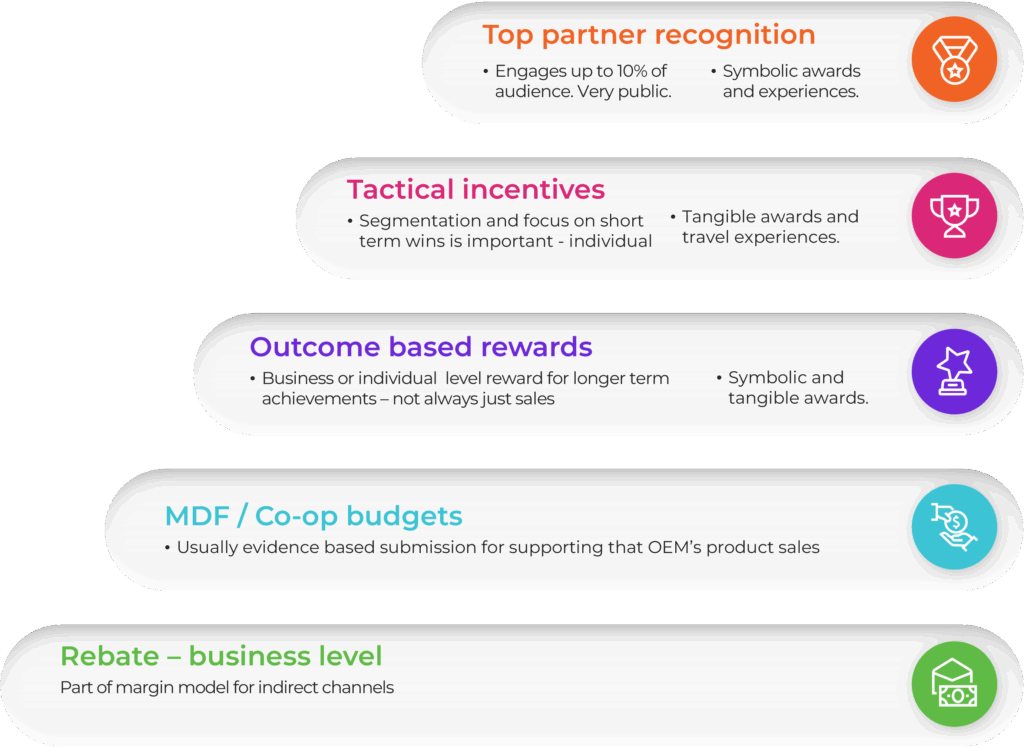
Total rewards levers to consider:
- Achievement and recognition: public leaderboards, peer shout‑outs, award moments
- Growth and mastery: funded certifications, learning pathways, specialist badges
- Experience and access: exclusive briefings, roadmap previews, co-marketing features
- Meaningful rewards: choice-based marketplaces, experiential rewards, team incentives
- Financials (still vital): rebates, margin boosters, stackable accelerators
Balance these levers not only against your program’s goals and partner maturity, but also against practical investment levels and regional nuances. The outcome is a more human, memorable experience that builds loyalty, not just throughput.
Avoid these common traps
- Paying for activity, not quality: Define quality gates (e.g., demo scheduled and completed with decision maker).
- Ignoring role clarity: If everyone is eligible for everything, no one feels responsible for anything.
- Over‑complicating claims: If proof is painful, participation will drop.
- One reward for all regions: Calibrate by market maturity and deal size.
- No communications plan: Behavior change needs sustained visibility
Reward the work that creates the win
When you reward the work that creates value, before, and after the transaction, you build a program partners want to engage with and a pipeline you can trust.
For more information on how BI WORLDWIDE can help your organization transform channel partner engagement, visit www.biworldwide.com.sg or contact us at enquiries@sg.biworldwide.com.