
Why MDF and rebates aren’t enough in channel incentives
Financial incentives motivate the partner business, not the individuals. Learn how to balance MDF, rebates and total rewards to build stronger loyalty.
Marketing Development Funds (MDF) and rebates are staples of channel programmes. They support marketing execution, protect margins, and contribute to partner profitability. They matter, but they are not enough on their own to create measurable business results.
When organisations rely exclusively on these financial levers, they unintentionally narrow partner motivation to transactional value rather than strategic loyalty. MDF and rebates strengthen the partner business, but they rarely influence the individuals who represent your brand, shape customer experience, and ultimately determine whether your solutions win.
This article explores why MDF and rebates have limits, how over‑reliance creates fragile loyalty, and how a broader incentive mix can transform partner engagement.
Why MDF and rebates aren’t the whole answer
1) Cash invites comparison, not loyalty
The moment money is involved; partners instinctively compare:
- Is this a good margin?
- Who offers a higher rebate?
- Which vendor funds more activities?
- Where is the best short‑term financial gain?
This creates ‘deal‑shopping’ behaviour. Partners move toward the richest offer, not necessarily the best partnership. It places a brand in the ‘me too’ category.
Design suggestion: Loyalty needs emotional and experiential anchors, not just financial ones.
Watch our Is cash king webinar to learn more about the risks of cash only rewards.
2) Financial tools motivate the company, not the people
MDF and rebates support the partner organisation, but they don’t directly motivate:
- Sales reps
- Pre‑sales engineers
- Technical architects
- Customer success teams
- Service and delivery roles
Yet these are the roles influencing customer decisions, championing your brand, and building value.
It’s the classic organisational equivalent of paying only a base salary and expecting discretionary effort.
Design suggestion: Recognise individuals as well as the business.
3) Over‑reliance creates a price‑chase ecosystem
When partners pick vendors based on rebate rates or MDF availability, loyalty becomes fragile and short‑term. Programmes devolve into:
- Margin comparison
- Incentive shopping
- Discount‑driven sales
- Minimal brand preference
This dynamic makes your channel strategy vulnerable to competitive offers.
Design suggestion: Emotional connection and brand affinity must balance economic incentives.
4) Cash rewards plateau in motivational power
Behavioural science shows that cash quickly reaches a motivational ceiling. Once the financial baseline is accepted as ‘fair’, additional cash delivers diminishing returns.
Partners stop being inspired and start asking:
- ‘Is this enough for the effort?’
- ‘Is another vendor offering more?’
Design suggestion: Non‑financial motivation is essential for sustainable engagement.
What partners value beyond financial incentives
Partners respond strongly to motivation that strengthens capability, builds confidence, and connects them more deeply to your brand.
1) Recognition
Public celebration of progress or success, not just final outcomes, builds pride and momentum.
2) Achievement and growth
Opportunities to build expertise, gain certifications, or master new solutions.
3) Status and access
Exclusive briefings, roadmap previews, early access to features, or high‑trust advisory groups.

4) Experience and reward choice
From experiential incentives to personal reward catalogues, choice increases perceived value.
5) Community and belonging
User groups, peer learning, and partner spotlight features create emotional alignment.
6) Rewards that equip their business
Tools, platforms, or resources that directly strengthen their operations and enable them to grow their business.
7) Incentives targeted to their business
Personalised programmes aligned to their business’s goals, maturity, and market focus

These elements generate intrinsic motivation, something MDF and rebates alone cannot achieve.
Apply a total rewards perspective
At BI WORLDWIDE, we encourage organisations to take a total rewards approach to their channel programmes. Adapted from employee engagement models, it helps you recognise the full spectrum of value partners deliver.
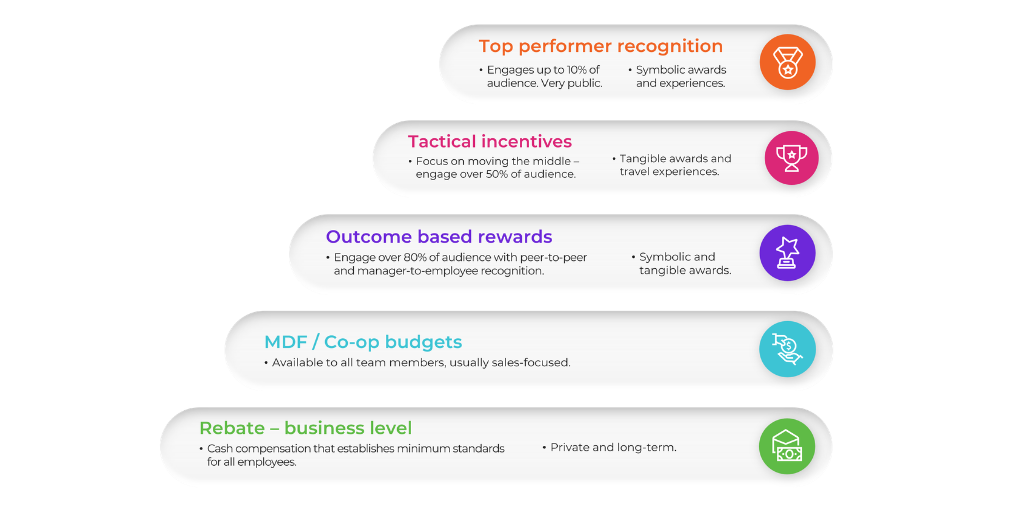
A total rewards lens expands incentives to include:
- Achievement: Levelled certifications, badges, mastery pathways
- Recognition: Spotlights, award moments, peer celebration
- Development: Learning journeys, role‑based enablement, funded training
- Experience: Events, group travel, access to specialists
- Community: Advisory councils, peer learning sessions
- Financial: Rebates, margin enhancements, accelerators
This approach motivates both the organisation and the individuals within it, creating a more human, rounded programme.
A balanced incentive model: business + behaviour
To create resilience and engagement, combine:
1) Business-level incentives
- Rebates
- MDF
- Co‑marketing funding
- Growth bonuses
- Partner tier benefits
2) Individual-level incentives
- SPIFFs
- Learning rewards
- Activity‑based points
- Certification challenges
- Recognition moments
- Team‑based competitions
3) Experience-level incentives
- Exclusive events
- Access to leadership
- Early product previews
- Specialist communities
Each layer plays a different motivational role, and together they create depth.
Common pitfalls (and how to avoid them)
- Equating MDF usage with motivation: MDF supports marketing spend; it doesn’t inspire behaviour.
- Ignoring individual contributors: The people doing the work need recognition, not just the business.
- Rewarding only completed deals: Reward the behaviours that lead to deals.
- Relying solely on discounting: Price wins the deal; value wins the customer.
- Using mechanics that feel ‘corporate-only’: People want progress, celebration, and meaning.
Beyond rebates is where real loyalty is built
Cash drives transactions. Total rewards drive loyalty. The strongest programmes use both and partners feel the difference.
Explore the full blog series
Dive into the full blog series to see the most common channel incentive design pitfalls and how to avoid them with simplicity, clarity, and partner‑focused design:

Why insight must lead channel incentive programme design
Build channel incentives on evidence, not assumptions. Learn how insight, segmentation and fit drive partner engagement, performance and loyalty

Why you should reward more than the sale in channel incentives
Transactional incentives limit impact. Learn how to motivate the behaviours that create revenue – enablement, presales, adoption – and build lasting loyalty.

Boost channel incentive engagement through better communication
Incentives fail when partners forget they exist. Learn how structured, multi‑channel communication keeps your programme visible, clear and motivating.

Why simple channel incentive programmes perform better
How does operational excellence drive channel incentive engagement, and what can you do to create a simple, intuitive structure your channel partners will use.
The best way to get started is to get in touch!
Speak to a member of our expert team to learn how our solutions can support your channel performance strategy.