
Business outcomes
Recognition that delivers results
When organizations recognize both performance and results, they don’t just build stronger teams. They build stronger businesses.
“The strength of the team is each individual member. The strength of each member is the team.”
– Phil Jackson, legendary NBA coach
Phil Jackson built championship teams by developing each player’s unique strengths. The same principle applies in business: when leaders recognize and develop each employee’s contributions, the entire organization performs better.
At BI WORLDWIDE, our operational expertise and global research confirm that helping employees focus on key activities (and recognizing them for results) translates directly to measurable business outcomes.
Recognition: the multiplying effect
To understand how different types of recognition drive engagement, we asked our global panel which forms of recognition they received most often.
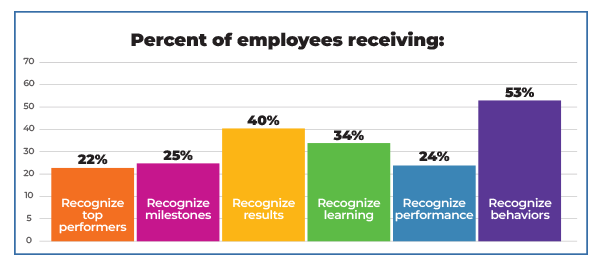
It wasn’t surprising that recognition for daily behaviors was the most common. These opportunities occur frequently and are easier for managers and peers to deliver in real time. Recognition for top performance and career milestones, on the other hand, was understandably less frequent.
But frequency isn’t the only story. We wanted to know if variety matters. Does receiving more types of recognition in a year lead to stronger engagement?
The data says yes, emphatically.
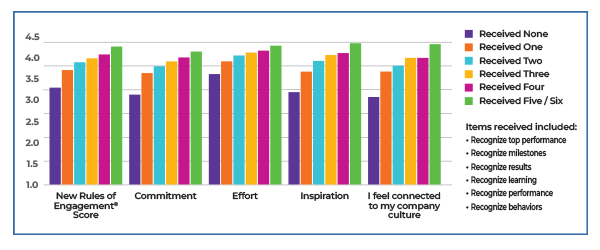
Employees who received multiple forms of recognition were significantly more engaged than those who received one or none. Bottom line: more recognition and more kinds of recognition create stronger engagement.
Recognizing results and performance: the winning combination
Next, we looked at the impact of recognizing performance and results compared to other types of recognition.
The pattern was clear. When employees are recognized specifically for achieving results or demonstrating performance excellence, their engagement levels climb higher than with any other recognition type.
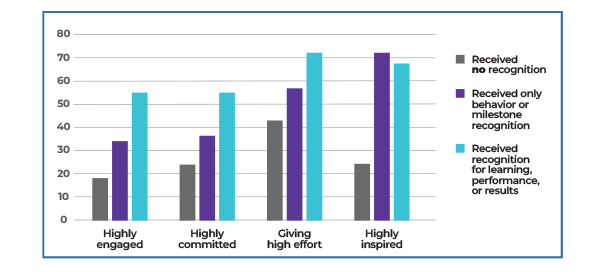
All forms of recognition boost engagement, commitment, and inspiration — but recognizing results and performance delivers the strongest return on investment.
From insights to ROI
Turning insights into business results requires deliberate design.
Barry Danielson, Vice President of Decision Sciences at BI WORLDWIDE, explains how our proprietary Impact Advisor tool helps organizations connect recognition to measurable outcomes:
“As we identify opportunities with customers, we use our Impact Advisor tool to focus conversations on key business challenges like turnover, productivity, safety, absenteeism, speed to competency, and model how enterprise-wide recognition programs can address them. We quantify potential improvements, forecast ROI, and track actual impact as the culture of recognition matures.”
Danielson notes that the business case is compelling:
“When a company has developed a recognition-rich culture, they can expect measurable gains across multiple outcomes: lower turnover, higher productivity, fewer safety incidents, reduced absenteeism, and greater customer loyalty. In one global manufacturing client, we observed a 49.3% higher retention rate among employees who received recognition compared to those who did not. When recognition included an award, retention increased by 64.7%.”
That’s not just engagement; it’s economics.
Translating recognition into business performance
How do these insights translate into measurable business success?
Christina Fortier, Solution Owner for PerformIQ® at BI WORLDWIDE, outlines four key benefits of recognition programs designed with results in mind:
1. The efficiency advantage
Efficiency isn’t luck; it’s focus. Balanced performance aligns teams, clarifies priorities, and keeps critical work front and center. Recognizing the behaviors that impact business results around that alignment drives engagement and motivation for frontline employees.
2. Clear expectations = better performance
Organizations that clearly link individual goals to strategy through balanced performance frameworks report measurable improvement. On average, more than half of their key performance indicators improve within the first few years of implementation.x
3. Misaligned frameworks reduce financial performance
When the metrics teams are measured on are not linked to strategic revenue or cost-savings goals, organizations incur hidden inefficiencies: duplicated effort, internal friction, lost opportunities. And that is a clear cost to business.
4. The revenue growth multiplier
Balanced performance doesn’t just track outcomes; it accelerates them. When goals, metrics, and recognition align, growth becomes predictable and scalable. Connecting KPIs to decisive action is how you impact your business. Data doesn’t drive growth. Employee decisions do.
A case study in recognition ROI
Fortier shared how BI WORLDWIDE partnered with a major telecommunications company to transform performance and engagement.
“We implemented the Five Star Performance Program to drive efficiency, service quality, and engagement across 60,000 associates. The program emphasized personal best goals, transparent performance tracking, and monthly, quarterly, and annual recognition for achieving Five Star status in key metrics like safety, efficiency, and customer satisfaction.”
The results? Extraordinary.
“Over eight years, the program generated $950 million in incremental revenue and $527 million in cost savings,” said Fortier. “Beyond financial results, it built a culture of accountability and continuous improvement, proof that recognition-based motivation can drive both engagement and operational performance.”
From insight to impact
Recognition is more than a feel-good exercise; it’s a performance multiplier.
When organizations recognize both performance and results, they don’t just build stronger teams. They build stronger businesses.
Coach Jackson would be proud: help each member of your team grow stronger, and the team becomes unstoppable.
Key takeaways:
- Recognition variety amplifies engagement.
- Recognition tied to performance and results yields the strongest ROI.
- BIW’s Impact Advisor and Perform IQ® tools link recognition directly to business outcomes.
- Recognition-rich cultures deliver quantifiable results: higher retention, productivity, and profitability.
- Balanced performance and recognition alignment create sustained business growth.
Hear from our expert
Christina Fortier, Solution Owner, PerformIQ®