
The New Rules of Engagement® global employee inspiration research report
Download the full report.
Jump to a section:
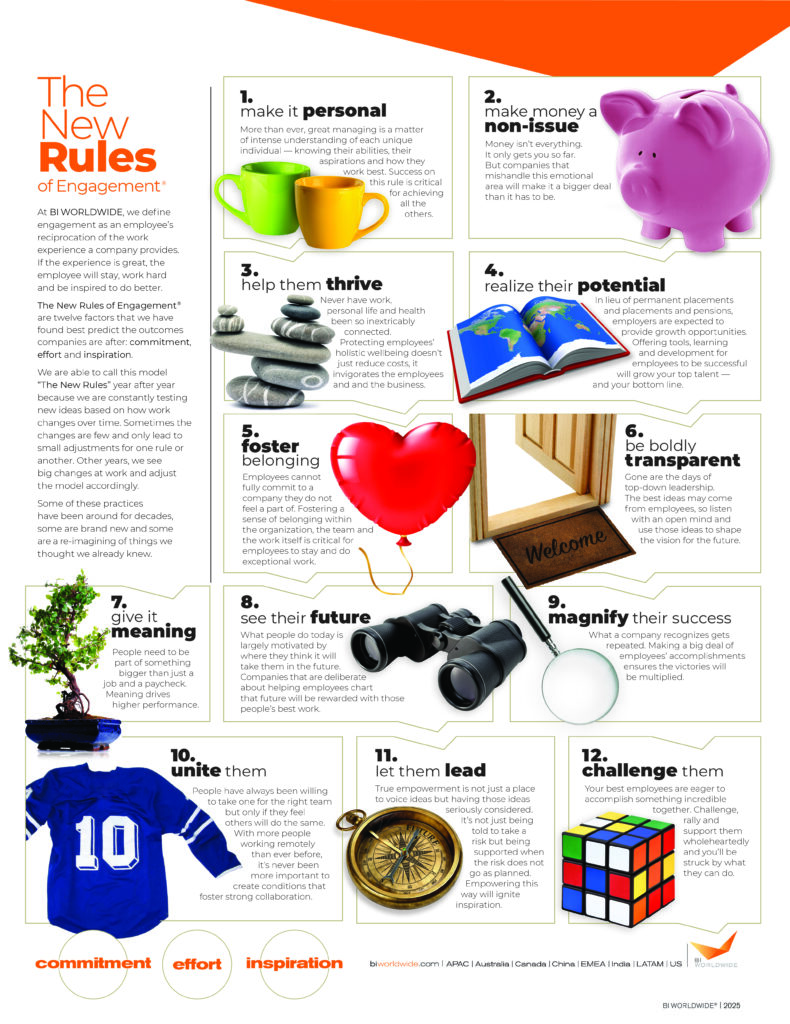
The New Rules of Engagement®
Insights behind the trends in employee inspiration
Recognition contagion
How recognition goes viral and why it matters
Feedback and recognition
Can 1+1=3? When two engagement drivers multiply impact
The change imperative
How to lead through uncertainty with intention
Artificial intelligence
From fear to force multiplier
Deskless employees
Close the gap for the frontline workforce
Milestones that matter
Moments that shape culture and strengthen connection
Compensation and recognition for salespeople
The 3×2 total rewards toolkit
Inspiration vs. compensation
Why cash alone can’t buy commitment
Business outcomes
Recognition that delivers measurable results
Ideas that drive change
The Linus Pauling effect: how volume fuels innovation
Communication breakdown
Is “TMI Syndrome” disengaging your sales force?
Daniel Patrick Moynihan once said,
“You have a right to your own opinion but not a right to your own facts.”
Foreword
BI WORLDWIDE focuses on the facts: real data on how organizations can engage and inspire employees across every role, industry, and corner of the world. Each year, The New Rules of Engagement® pushes that research further, translating what we’ve learned into practical action.
This year, we explore the questions shaping today’s workplace:
- How can we build a culture of recognition that fuels measurable business outcomes?
- What makes recognition contagious?
- How do we engage and inspire “deskless” employees across manufacturing, retail, and distribution?
- How can cash and non-cash tools be used to attract, retain, and motivate sales producers?
- What role do milestone celebrations play in strengthening connection?
- How is artificial intelligence reshaping the employee experience?
- How can we manage constant change while keeping employees engaged?
- How do we tap into employee creativity and turn ideas into results?
- In an era of nonstop noise, how do we communicate clearly enough to be heard?
There’s no single playbook for applying these insights. A manufacturer with hundreds of frontline employees faces different realities than an automotive dealership or a digital start-up. A long-tenured workforce celebrates milestones differently than a company scaling at full speed. And recognition for a patentable innovation looks different from recognition for improving a daily process.
That’s where the real challenge (and the fun) begins: turning facts into action. When organizations connect insight to execution, they don’t just improve culture; they transform performance.
Let’s get started.
The New Rules of Engagement®
Each year, our research sheds new light on what truly drives engagement and what holds it back. This year’s findings reflect a workplace in motion: recognition that spreads like wildfire, artificial intelligence reshaping productivity, and managers redefining what leadership looks like in a world of constant change.
From deskless employees craving connection to salespeople balancing compensation and meaning, employees everywhere are asking the same question: “Does my work matter, and do you see it?”
The data says it does. The challenge is what you do with it.
We could fill volumes with every insight our respondents shared, but this year we’re focusing on eleven key trends, each one actionable, measurable, and ready to use:
- Making inspiration go viral
- Feedback and recognition
- Managing change in challenging times
- Artificial intelligence
- Deskless employees
- Celebrating milestones
- Compensation for salespeople
- Inspiration vs. compensation and recognition
- The power of ideas
- Business outcomes
- Addressing the challenges of poor communication
The insights behind these trends are more than numbers. They’re proof that engagement isn’t accidental. It’s built through design, data, and discipline.
The opportunity now? Turn insight into impact.
Recognition contagion
How recognition goes viral and why it matters
Recognition isn’t a perk; it’s one of the most powerful tools for improving performance. When employees feel their successes are seen and celebrated, they don’t just feel happier; they work harder and think bigger.
The data speaks for itself:
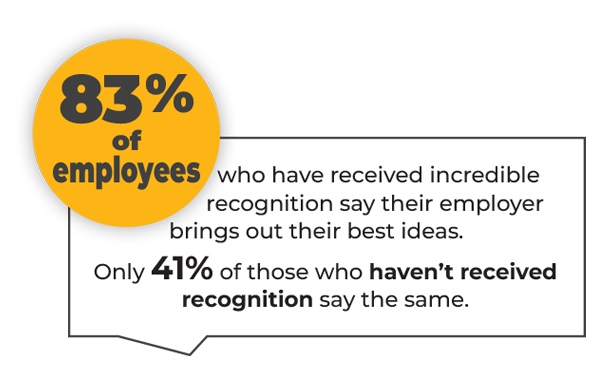
That’s not coincidence. That’s causation.
If recognition is this powerful, how can we create more of it? One answer lies in a principle with deep behavioral roots: social contagion.
The Oxford Dictionary defines it as:
“the spread of ideas, attitudes, or behavior patterns in a group through imitation and conformity.”i
Just like emotions or habits, recognition can be contagious.
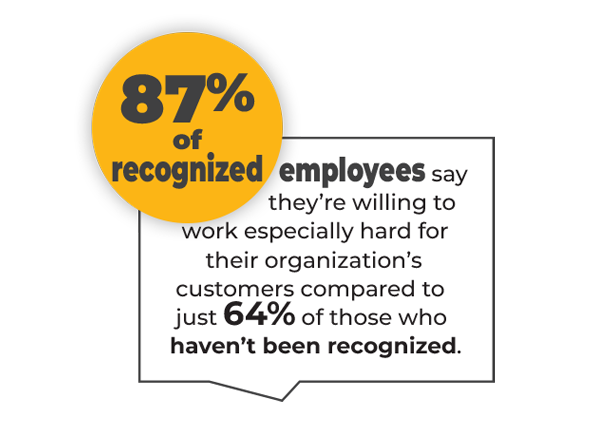
And the data confirms it: Employees who received recognition in the past month are 2.9x more likely to have sent recognition themselves. Recognize someone, and they’re far more likely to recognize someone else. That’s the ripple effect that turns individual appreciation into an organizational movement.
To understand this dynamic more deeply, BI WORLDWIDE analyzed the recognition program of a retail company with roughly 12,000 employees. Over a 60-day period, employees sent more than 33,000 recognition messages, (an average of 539 messages per day) that was received by 64% of the workforce.
Most of these messages were public, allowing employees to view and celebrate one another’s successes. Employees could send either group recognitions (to multiple recipients) or individual recognitions (one-to-one).
A typical group message might read:
“Team – I am so proud of all of you for delivering on our sales goal last week! You made such a large impact on the area’s performance, and I want to say thank you.
Thank you for your focus on the customer, on ensuring operational excellence, and on driving results! Congrats to the best team for making goal – 110%!”
Authentic. Heartfelt. Shared success on full display.
But the tone of individual messages feels different. It’s personal, specific, and deeply human:
“It’s officially six months today since you added me to your team. I wanted to take the time to say THANK YOU! You’re an AWESOME manager and such a pleasure to work with.”
Another read:
“Congrats for always being such a team player and attracting people with your smile. You are such an energetic person with a golden heart. Your laugh is so contagious and customers just vibe with your personality. Keep up the great energy.”
Both types of recognition matter, but one proved far more contagious. When we compared the next several weeks of data, employees who received a personal recognition were significantly more likely to send a recognition message than those who received a group one.
Why? Because individual recognition hits a different emotional register. It says you matter, not just your team. That doesn’t mean group messages don’t belong. They’re powerful for celebrating collective success, as in the example of the manager praising their team for exceeding 110% of their sales goal. But group messages should be complemented by personal recognition because culture change happens one authentic message at a time.
To make recognition contagious, leaders need to:
- Pay close attention to individual contributions.
- Look for smaller moments that might otherwise go unnoticed.
- Revisit long-tenured employees whose consistent impact may be taken for granted.
- Listen to peers, customers, or partners who can reveal unseen wins.
Yes, it takes effort. But the payoff is exponential. Recognition spreads when it starts personally.
Want to make recognition more contagious? Make it personal.
Key takeaways:
- Recognition doubles creative output and effort – backed by data.
- Social contagion is real: recognition inspires recognition.
- Individual recognition sparks stronger cultural momentum than group praise.
- Group messages build unity, but personal messages build commitment.
- Authenticity fuels repetition; recognition done right becomes self-sustaining.
Hear from our expert
Feedback and recognition
Can 1+1=3? When two engagement drivers multiply impact
Can you turn pewter into gold? The alchemists of old tried (and failed) to defy nature. But when it comes to employee engagement, it turns out that combining two seemingly simple elements—feedback and recognition—can create something that feels a lot like workplace alchemy.
At BI WORLDWIDE, we see it every year in our data. Each factor matters on its own, but together, they multiply impact in ways that defy logic.
The power of feedback
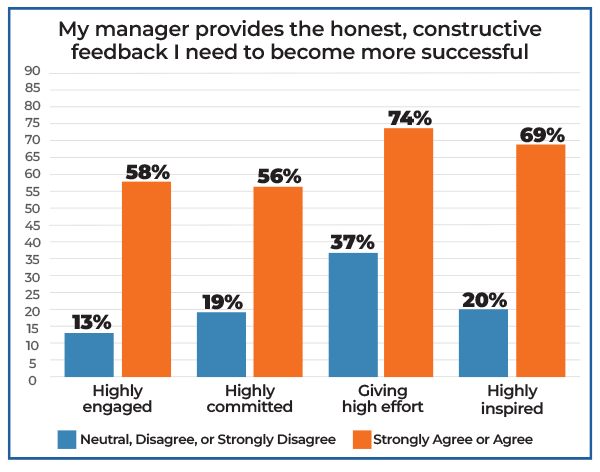
In our “Make It Personal” rule, we asked employees if they receive constructive feedback about their work.
The results are clear:
Employees who agree their manager provides honest, constructive feedback are 9.1x more likely to report being highly engaged.
That aligns with outside research too. Quantum Workplace found that less than half of employees believe their organization’s approach to performance management is effective, efficient, or engaging, and two-thirds of those considering leaving their job cite dissatisfaction with performance management tools. ii
A recent Harvard Business Review article goes even further:
“What’s often missing from the conversation about the importance of feedback is the real reason why it matters: Feedback is a critical tool for helping employees find deeper meaning in their day-to-day work.” iii
Roxanne Henselman, VP of Talent Management & Development at Workday, echoes this:
“Employees crave feedback; they want to know where they stand. Being transparent with them about how they’re performing helps build trust and alignment.” iv
When feedback is done right, employees notice:
“My manager listens to me and asks how I’m doing. And even where there’s opportunities for me to get better, the feedback is never hurtful. She genuinely wants to help me.”
“I just had my annual review. I had a great year and got a nice pay raise! The best part is my manager meets with me regularly, so I always know where I stand. I don’t feel like my annual review is ever a surprise.”
Still, not every story is positive.
“Feedback? What feedback? I rarely talk to my manager, and when I do, it’s only because they need help on a project that’s important to them. The annual review is just for compliance and nothing else.”
“How they evaluate employees here is a joke. Management has their favorites, and the favorites are going to get the biggest raises and best opportunities. It doesn’t make any difference what you do. If you’re not one of the ‘in crowd,’ you’re not getting good feedback.”
Too many employees still feel feedback happens to them instead of for them.
Recognition: the amplifier
In our “Magnify Success” rule, we asked how confident employees are that their good work will be recognized. The connection between recognition and retention is undeniable.
Employees who feel confident they’ll be recognized are 8.4x more likely to say they’re committed to staying with their organization.
When people feel appreciated, their tone changes completely:
“(The company) recognizes employees when we do well and helps build on our strengths. I love it here and see myself thriving for a long time.”
“I’ve worked as a service technician for several companies and I’ve never felt as appreciated as I do here. They truly care about their staff. It’s no wonder everyone in my field wants to work here.”
And yet, many others tell a different story:
“I give a lot to my job, and my supervisor never offers praise. I even shared an idea to improve workflow, and he passed it off as his own. My resume’s ready, and I’m out the door.”
“We’re treated like disposable bottles. Here today, gone tomorrow. There’s no respect or appreciation for the hard work we do.”
Recognition without feedback is hollow. Feedback without recognition is demoralizing. Together, they’re transformative.
The alchemy of engagement
When employees report receiving both constructive feedback and meaningful recognition, engagement skyrockets. The data shows that delivering both consistently multiplies commitment, motivation, and intent to stay far beyond either factor alone.
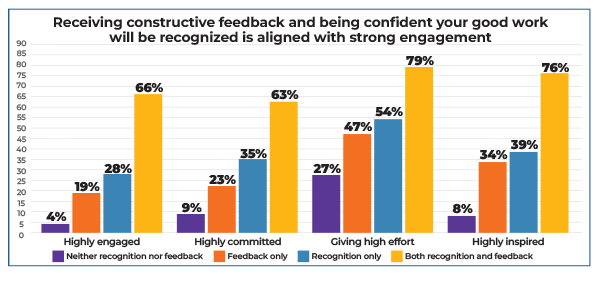
The message is clear: Feedback and recognition aren’t competing priorities; they’re complementary forces.
The right tools make this synergy possible. BI WORLDWIDE’s Elevate platform integrates recognition with performance management, helping leaders provide both ongoing feedback and authentic appreciation.
When organizations invest in systems and culture that support both, something remarkable happens. Performance improves. Retention strengthens. People grow.
That’s not alchemy. That’s design. Just like turning pewter into gold.
Key takeaways:
- Employees receiving constructive feedback are 9.1x more likely to be highly engaged.
- Employees confident they’ll be recognized are 8.4x more likely to stay connected.
- Feedback builds meaning; recognition builds belonging. Together they multiply impact.
- Manager transparency and trust are the foundation of both.
- Integrated tools like Elevate make feedback and recognition habitual, not optional.
Hear from our expert
Beth Sundberg, Vice President, Technology Strategy
The change imperative
How to lead through uncertainty with intention
“Change is good. You go first.”
That single phrase captures one of the biggest challenges in leadership today: everyone agrees change is necessary until they’re the ones asked to make it.
Change, especially in large organizations, is rarely smooth. It’s messy, inefficient, and often expensive. Without thoughtful planning, change efforts can leave leaders frustrated and employees demoralized.
Whether it’s implementing a new HRIS platform, launching a benefits portal, onboarding employees after an acquisition, or rolling out a new recognition program, change management must be intentional or the cost is far more than financial.
The human toll of constant change
Our research shows the modern workplace is in perpetual motion, and employees are feeling it.
- 60% of employees report experiencing constant change within their organization. When change is frequent but poorly supported, with limited training, resources, or leadership alignment, employees quickly feel overwhelmed and resistant. The result? Mistakes, service breakdowns, and disengagement.
- 31% of employees say they’re burnt out from ongoing change. Burnout doesn’t just reduce motivation; it corrodes trust. When change becomes chaos, people disengage, leaders lose credibility, and turnover accelerates.
Without a structured approach, organizations risk cascading problems:
- Employee resistance and low morale
Unclear or sudden change breeds confusion, frustration, and pushback. - Decreased productivity
Poorly supported employees can’t adapt quickly, slowing down progress. - Increased errors and rework
Gaps in training or communication compromise quality and compliance. - Missed deadlines and inflated budgets
Disorganization and misalignment derail timelines. - Loss of trust in leadership
When employees feel blindsided, it erodes confidence in future initiatives.
The B.U.I.L.D. for Change model
To help clients navigate transformation with confidence, BI WORLDWIDE developed the B.U.I.L.D. for Change model, a practical, behavioral-science-based approach grounded in the work of Harvard’s Dr. John Kotter and our long-time partner Dr. Kurt Nelson.
Each phase helps leaders anchor change in data, empathy, and measurable results.
Begin:
Initiate with intention and clarity.
Define business outcomes and governance before execution begins.
Understand:
Assess the current state.
Gather data and insights to benchmark employee sentiment and readiness, including perceptions of change pace and well-being.
Innovate:
Develop strategies rooted in behavioral science.
Turn insights into actionable programs that inspire adoption.
Lead:
Support others through the transition.
Use proven principles from Kotter and Nelson to communicate, train, and measure outcomes—such as turnover, safety, or customer advocacy—before and after the change.
Demonstrate:
Evaluate and iterate.
Use evidence to continuously improve and sustain progress.
Each phase can be tailored to an organization’s unique culture and infrastructure. BI WORLDWIDE’s model can also integrate seamlessly with other established change management frameworks when clients already have one in place.
Change done right: a case study
Before working with BI WORLDWIDE, a large financial institution lacked a unified recognition strategy. Their efforts were fragmented: multiple informal programs, no connection to business goals, and inconsistent visibility across teams.
We partnered with them to design and implement a cohesive recognition and rewards program that aligned directly with desired employee behaviors and customer experience outcomes.
The results were striking:
- 31% decrease in turnover
- $10.4 million in cost savings
- 4-point increase in customer satisfaction
That’s the ROI of change done right: when people are equipped, aligned, and supported, transformation drives measurable results.
From resistance to readiness
Managing change isn’t about avoiding discomfort; it’s about guiding people through it. When leaders address the “you go first” mentality with empathy, data, and clear communication, they build trust instead of fear.
Change done well isn’t just a process; it’s a cultural advantage.
Key takeaways:
- 60% of employees experience constant change, and 31% report burnout.
- Poorly managed change erodes morale, trust, and productivity.
- The B.U.I.L.D. for Change model provides a structured, science-backed framework.
- Success requires clarity, empathy, and continuous measurement.
- When supported by leadership, change becomes a growth accelerator – NOT a distruption.
Hear from our expert
Mark Hirschfeld, Vice President, Consulting Services and Strategic Partnerships
Artificial intelligence
From fear to force multiplier
A year ago, we asked employees how they felt about the introduction of AI in the workplace. The results were mixed: equal parts excitement and uncertainty.
- About half of respondents had personal experience using AI at work, with engineers, managers, and technologists leading adoption.
- The majority believed AI could help streamline tasks or improve efficiency.
- Roughly half felt prepared to use these tools.
- Many expressed concerns around privacy, security, and job replacement.
Experience mattered. Employees who had used AI firsthand felt calmer, more confident, and more optimistic about its potential.
So how do employees feel one year later?
AI adoption is rising
In 2025, the numbers are clear: employees are engaging with AI at higher rates than ever before, though 30% of our panel still report they haven’t (as far as they know) used AI tools at work.
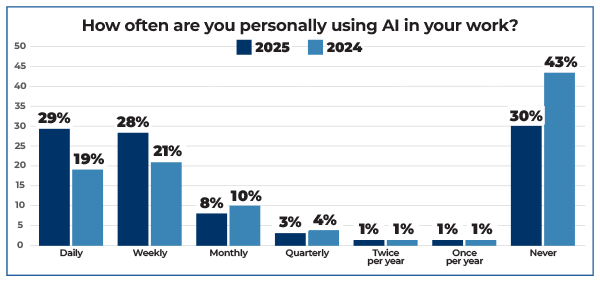
Despite that gap, overall sentiment has improved. Employees are more prepared, more curious, and more positive about AI’s role in their daily work.
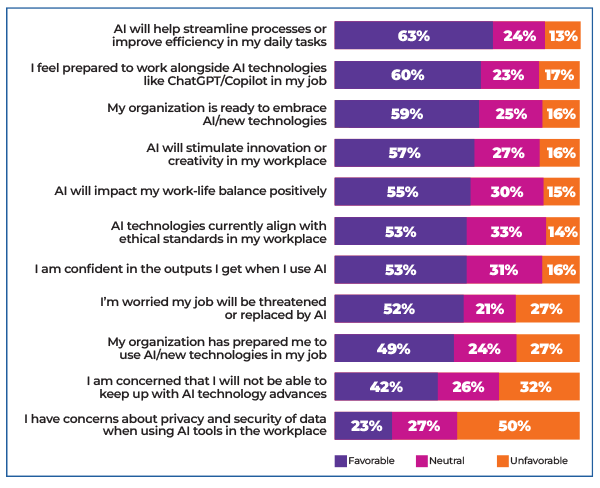
The biggest jump came from two areas:
- Employees now feel better equipped to use AI tools effectively.
- Many believe AI will help them achieve better work-life balance.
Not everything trended upward. Concerns about data privacy and security increased slightly, and anxiety about keeping pace with AI’s evolution stayed constant. Even so, optimism outweighs apprehension, a shift that signals growing maturity in how employees view this technology.
How employees are using AI
When asked how they currently use AI, employees named five main categories:
- Content creation and enhancement
- Information processing and analysis
- Automation and efficiency
- Personalization and engagement
- Customer and employee support
These patterns reflect both opportunity and evolution. As employees integrate AI into more areas of work, productivity gains (and the need for thoughtful leadership) will only increase.
Looking forward, we anticipate the next phase of workplace AI will focus on four key developments:
1. Generative AI
Fueling creativity and speed
2. Agentic systems
Automating complex, multi-step tasks
3. Predictive capabilities
Helping anticipate needs and trends
4. Feedback mechanisms
Improving systems through continuous learning
Leaders are defining the future
Satya Nadella, CEO of Microsoft, captures the moment perfectly:
“AI is the defining technology of our times. It’s augmenting human ingenuity and helping us solve some of society’s most pressing challenges.” v
But technology alone isn’t enough. Culture must evolve with it.
Dr. Jessica Kriegel, Chief Scientist at Culture Partners, emphasizes:
“CEOs must foster a culture of learning and adaptation to help their workforce develop the skills necessary to thrive in an AI-driven future.” vi
That starts with open communication, consistent training, and ongoing recognition which helps employees view AI as a tool for growth, not a threat.
AI that makes recognition more human
At BI WORLDWIDE, we’re not just studying AI’s impact; we’re building it into the employee experience.
Andrea Imsdahl, Director of Strategic Partnerships at BI WORLDWIDE, explains how thoughtful AI can make recognition more personal and more meaningful:
“Our first IBM watsonx-powered tool, Recognition Assistant, was deployed in January 2025 to elevate the employee recognition experience. Within IBM’s Recognition Center, employees engage with an intuitive, AI-powered wizard that guides them through crafting thoughtful messages. The assistant prompts users to reflect on the impact of their colleague’s contributions and ensures the tone is appropriate, authentic, and aligned with the user’s voice. It identifies and removes unintended negative sentiment, offers suggestions to enhance tone and clarity, and helps ensure every message feels meaningful and human. It’s not just about writing a message; it’s about making it matter.”
And the results speak for themselves:
“Even though IBM already had a mature culture of recognition, the results have been amazing,” Imsdahl says.“We’ve seen a 20% increase in the daily number of recognitions sent. Sixty-five percent of users who generate a message with Recognition Assistant send it as their final message. And we’re saving IBMers more than 2,100 hours per month by making it easier to recognize one another.”
That’s the equivalent of one full-time employee’s worth of hours saved every month while making recognition more authentic.
AI’s real lesson: be more human.
As the data shows, AI isn’t replacing the human experience; it’s enhancing it.
By helping employees connect, personalize, and communicate with empathy at scale, AI is becoming not just a productivity tool but a cultural catalyst.
That’s why we’ve built Elevate Intelligence. Our agents can identify meaningful contributions, suggest fair awards, and alert managers when great work might otherwise go unseen. But people are still the ones sending recognition.
It turns out that when we use AI to be more human, everyone wins.
Key takeaways:
- AI adoption and positivity are rising, though 30% still haven’t used it at work.
- Employees feel more prepared and believe AI supports better work-life balance.
- Privacy and data concerns persist, but optimism now dominates.
- Leadership must build cultures of learning, adaptation, and trust.
- BI WORLDWIDE’s Recognition Assistant proves AI can drive both authenticity and efficiency, making recognition faster, smarter, and more human.
Hear from our expert
Andrea Imsdahl, Director, Strategic Partnerships
Deskless employees
Close the gap for frontline workforce
Two years ago, we examined the state of deskless employees, the essential workers who keep the world running but are often furthest from corporate culture. The question then was: how do you engage a workforce that doesn’t sit behind a desk? Two years later, the question still stands.
Who are “deskless employees”?
- Employees in production, manufacturing, distribution, retail, healthcare, hospitality, and some sales roles.
- Those once labeled “essential” or “frontline” during the pandemic.
- Employees once described as “disconnected,” a term that no longer fits, given that most now have mobile devices.
They make up the majority of the global workforce. Yet, despite being critical to business continuity, they remain undervalued and under-engaged.
The progress and the gap
Two years ago, we reported that only 36% of deskless employees received training and 34% received recognition on their mobile devices.
In 2025, those numbers have improved slightly: 42% now receive training on their device, 38% receive recognition digitally.
But the gap between deskless and office-based employees remains wide. Our research shows the consequences clearly. Employees who receive incredible recognition are 8.5x more likely to be inspired than those who don’t, and inspired employees are 6.9x more likely to say they plan to stay with their employer for the next 12 months. When recognition and training are missing, engagement lags, and turnover rises.
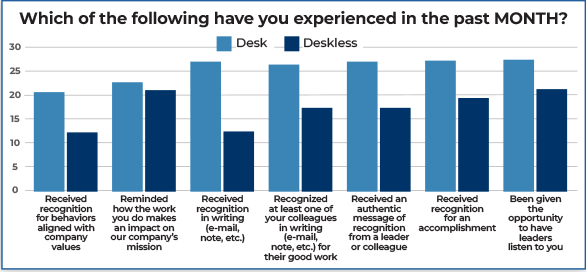
Deskless employees are still struggling to experience the benefits we know drive engagement. Even on fundamental cultural measures like trust, communication, and inclusion, they report significantly lower scores than their desk-based peers:
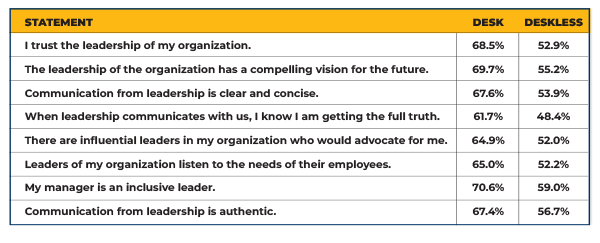
Those numbers tell a clear story: deskless employees don’t just need more messages. They need more meaningful connection.
The communication divide
Deskless employees have access to multiple communication channels, but they’re often underutilized.
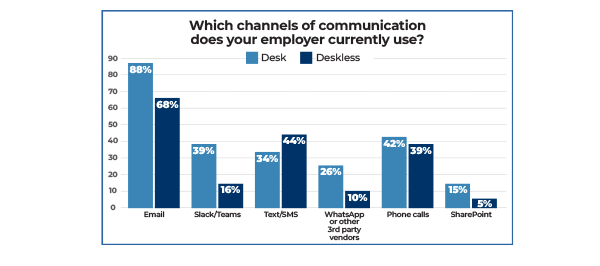
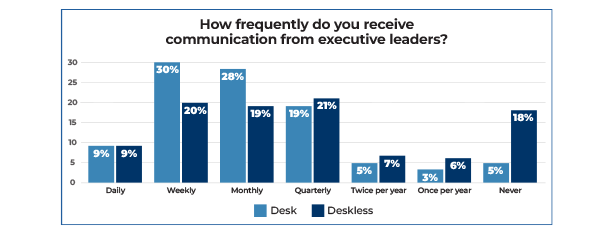
Generally deskless employees feel the frequency of communications is good, but communications to this audience from executives could improve.
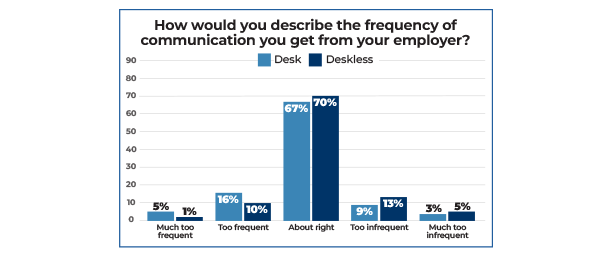
The fix isn’t simply “more communication.” It’s smarter, more personal communication using the right channel for the right audience, and ensuring that messages from leadership feel authentic, not transactional.
Recognition as connection
Beyond communication, recognition remains one of the most powerful engagement tools for deskless employees.
Our research shows that:
- Recognizing employees for behaviors aligned with company values builds stronger connection to mission.
- Written recognition from supervisors and peers increases perceived fairness and belonging.
- Even simple acts like listening, acknowledging, effort, and celebrating wins serve as powerful forms of recognition.
Recognition isn’t a program; it’s a signal: You matter, even if we don’t see you every day.
Spotlight: the automotive industry
One of the clearest examples of this challenge (and opportunity) comes from the automotive industry, particularly among service technicians.
The sector is projected to grow 3% per year, and as vehicles become more complex, demand for skilled technicians will only rise. Yet, the number of open roles already exceeds the number of qualified applicants, and retirements among Baby Boomers will widen that gap.vii
In other words, engaging and retaining dealership employees is no longer optional. It’s a survival strategy.
Jon Kraus, Vice President of Automotive at BI WORLDWIDE, explains:
“Original Equipment Manufacturers (OEMs) and their channel partners are looking for new and inventive ways beyond compensation to attract, develop, and retain talent in an increasingly competitive and mercenary market. And, in many cases, it’s challenging them to look at areas of the OEM-to-channel relationship that were overdue for an overhaul but were easy to kick down the road when sales and talent were strong.”
He continues:
“OEMs want to change the perceived value proposition for new channel associates by creating a consistent, cohesive experience that simplifies day-to-day OEM-to-channel interaction. It all starts by cutting the clutter.”
Amy Patel, Director of Voice of the Customer and Data Governance at Toyota Motor North America (TMNA), saw the same challenge:
“The industry condition Jon outlines mirrors what we saw as we started to critically evaluate how TMNA engaged and supported our dealership teams. It was an assortment of related, but disconnected touchpoints: learning and certification, rewards, sales recognition, parts and service recognition, dealer communications, regional contests. Dozens of dashboards and reporting sites.”
Patel continues:
“Each program worked fine on its own, but they were disconnected. That meant more confusion, more work for dealer teams, and ultimately lower satisfaction and higher turnover. Each internal department managed its own system independently, without considering interconnectivity.”
Her takeaway was simple:
“The audience mandate was clear: make it easy for us to understand what we need to do to be successful, what our priorities are, how we’re performing, and where to focus our day-to-day efforts.”
That insight led to the creation of the Toyota Dealership Engage Hub, developed in collaboration with BI WORLDWIDE. It’s a unified digital experience designed to simplify learning, recognition, and communication for dealership associates nationwide.viii
The result: greater clarity, consistency, and connection across the channel.
Bridging the distance
Deskless employees aren’t disengaged because they’re disinterested. They’re disengaged because they’re less connected to information, recognition, and leadership visibility.
Closing that gap requires more than technology. It takes intentional design, grounded in empathy, behavioral science, and human understanding.
When organizations invest in the experience of their deskless workforce, they don’t just improve engagement; they strengthen the backbone of their business.
Key takeaways:
- Deskless employees remain under-recognized and under-trained, despite modest gains.
- They lag 10-15 points behind office peers on trust, communication, and inclusion.
- Recognition and authentic communication drive belonging and retention.
- Automotive industry insights prove digital unification improves satisfaction and reduces turnover.
- The Toyota Dealership Engage Hub is a model for connecting deskless talent through simplicity and alignment.
Hear from our expert
Jeanne Tompkins, Vice President, Automotive Solutions Group
Milestones that matter
Moments that shape culture and strengthen connection
Service anniversary recognition dates back more than a century. In the early industrial era, companies began formally honoring employees for 10, 20, or even 30 years of service which were symbols of loyalty and stability that built both pride and reputation.
What started as a gesture of longevity has evolved into something deeper: a cornerstone of culture.
In today’s workplace where tenure is shorter and loyalty is earned rather than assumed, service anniversaries remain a powerful opportunity to recognize contribution, build connection, and celebrate identity.
Recognition as a cultural pillar
Research within The New Rules of Engagement® framework consistently shows that recognition is a key pillar of culture, and service anniversaries are one of its most enduring forms.
Wellbeing
The company supports their overall wellbeing, including mental and physical health.
Recognition
Recognition is provided fairly, and team members are confident that if they do good work they will be recognized.
Purpose
Team members feel a sense of purpose, are connected to the mission, vision and values, and feel a part of something larger than themselves.
Leadership
Leaders are trustworthy, listen, support team members health and wellbeing, and have a compelling vision for the future.
Belonging
It is safe to express your opinion, be unique, and there is a strong sense of teamwork.
When employees receive a service anniversary award, they are 2.3x more likely to agree they feel connected to their company culture.
That connection runs deep. Celebrating key milestones not only reinforces engagement but strengthens relationships and belonging.
Read how employees describe the impact in their own words:
“I love working here because I feel seen and truly appreciated. Every time I hit a milestone, my team celebrates me. It’s motivating and makes me want to grow even more.”
“Being recognized for my work anniversary has made me feel valued. It’s not just about the job; it’s about the people who notice your effort.”
“When my boss called out my five-year anniversary in our team meeting, I was moved. It was so nice hearing the stories they shared about my work. I felt truly seen and appreciated.”
“When I joined, I never imagined how much my contribution would be celebrated. Every moment of celebration reminds me why I love being part of this team.”
The data behind meaningful milestones
Amy Stern, Vice President of Employee Performance at BI WORLDWIDE, recently conducted a study to understand what makes milestone moments meaningful.
BIW surveyed employees who had either received a service anniversary award or contributed to someone else’s recognition. The findings were clear:
The more contributors, the more memorable the celebration.
More than a quarter of employees received zero contributions; another 29% received three or fewer. But the most meaningful and memorable celebrations had four or more contributors.
Peer contributions are as powerful as leadership contributions.
Inviting peers to participate creates inclusivity and shared ownership.
Engagement rises with contribution count.
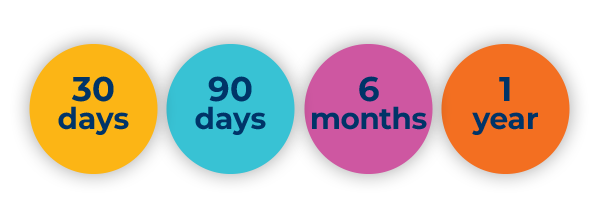
Those who received seven or more contributions reported the highest engagement levels; ten or more was best.
Hear from our expert
Compensation and recognition for sales people
The 3×2 total rewards toolkit
(Co-authored with Rob Bentley, Managing Director, Executive and Sales Compensation, Gallagher)
The world of sales is changing fast, and the way we compensate, motivate, and retain top performers must evolve with it.
Today’s sales leaders face new realities:
- AI is reshaping the selling process and the tools reps use to serve customers.
- Diversity and inclusion are redefining what modern sales teams look like.
- Information overload is fragmenting focus and productivity.
- Compensation for talent is fiercer than ever.
Creating a true competitive advantage now depends on how organizations combine compensation, recognition, and development to attract, inspire, and retain top salespeople.
Understanding the sales employee value proposition
Every sales organization must answer three questions:
1. Why do salespeople join?
2. Why do they stay?
3. What motivates them to outperform expectations?
Through BI WORLDWIDE’s research and client work, we’ve identified 18 drivers of the sales employee value proposition, from culture and recognition to equity and career development.
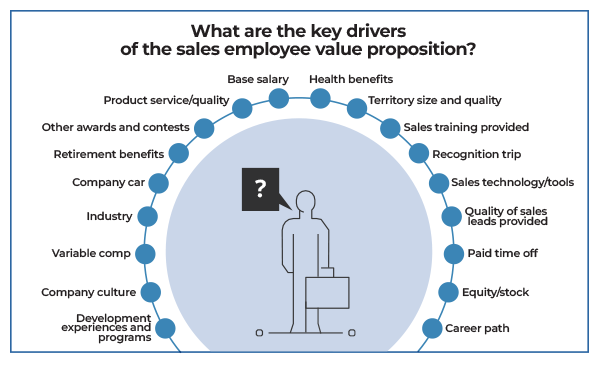
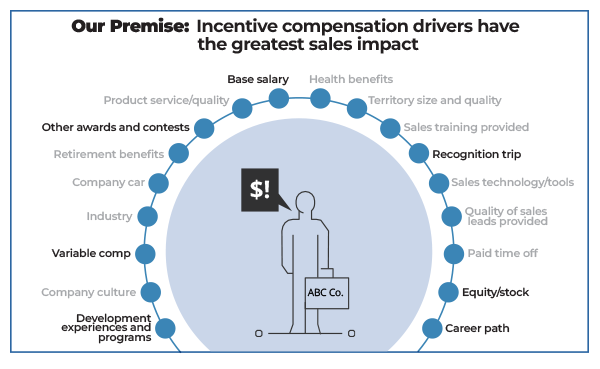
Among these, incentive compensation drivers have the greatest behavioral impact.
These include:
- Base salary
- Variable compensation
- Awards and contests
- Recognition
- Equity or long-term incentive (LTIs)
- Career pathing and development experiences
The 3×2 framework: cash, non-cash, and time
To help sales leaders design the right mix, we use a 3×2 total rewards toolkit, a simple but powerful model that classifies rewards across two dimensions:
- Cash vs non-cash (monetary vs. experiential or symbolic)
- Short-, medium-, and long-term effectiveness
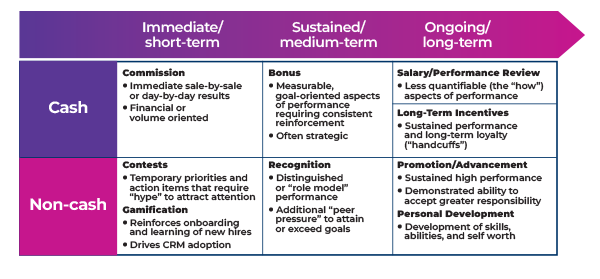
In this framework:
- Short-term tools (monthly to quarterly) include commissions, bonuses, and contests.
- Medium-term tools (quarterly to annual) include recognition programs, gamified challenges, and performance reviews.
- Long-term tools (annual and ongoing) include promotions, LTIs, and development opportunities.
Most companies focus heavily on the short term, but true differentiation comes from mastering the full spectrum.
What salespeople value most
Salespeople told us, loud and clear, what matters to them most:
- Public acknowledgement in meetings or newsletters
- Monetary rewards like bonuses, raises, or gift cards
- Personal thank yous from leaders or peers
- Awards and certificates
- Promotions and growth opportunities
- Team celebrations and shared wins
- Positive feedback from clients or customers
Recognition amplifies compensation; it adds meaning to money.
How fair pay and recognition work together
Our research examined two key engagement drivers:
- Whether salespeople feel they are paid fairly, and
- Whether they feel confident their good work will be recognized.
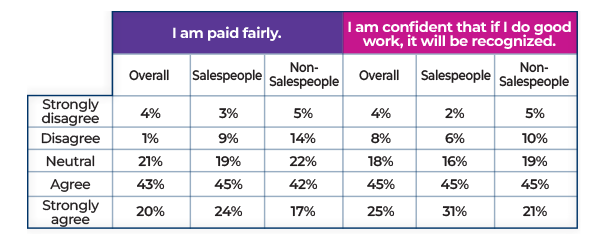
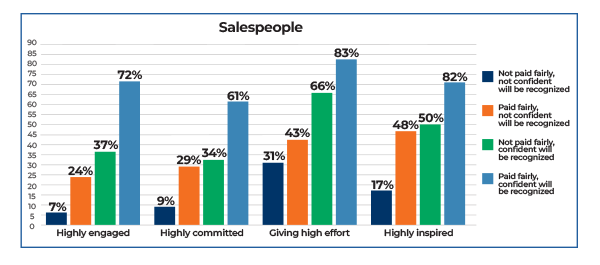
Recognition plays an outsized role in driving engagement. Salespeople who feel both underpaid and unrecognized score dramatically lower on engagement across every metric.
Activating the levers
The 3×2 model helps sales leaders decide which levers to pull based on their business challenge.
- Retention challenge? Lean on long-term tools like LTIs, career pathing, development.
- Performance challenge? Focus on short-term levers like contests, gamification, recognition.
- Attraction challenge? Highlight total rewards transparency and culture alignment.
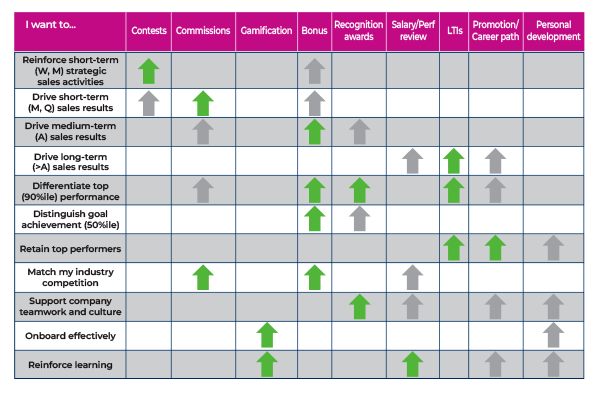
Using this balanced approach, organizations can:
- Strengthen their employer brand
- Differentiate in a competitive talent market
- Increase both sales performance and retention longevity
Turning insight into action
Cash motivates, but culture retains. Recognition, growth, and meaningful work transform a compensation plan into a commitment plan.
Key takeaways:
- Sales compensation must evolve with technology, diversity, and shifting employee expectations.
- Salespeople who feel both fairly paid and recognized are significantly more engaged.
- The 3×2 Total Rewards Toolkit helps leaders balance short-and long-term motivators.
- Recognition adds meaning to compensation and strengthens retention.
- Aligning the right levers to the right business goals turns compensation into a competitive advantage.
Hear from our expert
Amy Stern, Vice President, Employee Performance Group
Inspiration vs. compensation
Why cash alone can’t buy commitment.
There’s a Seinfeld episode where Kramer outshines Jerry by giving Elaine the birthday gift she really wanted: a wooden bench. Jerry gave her cash. The bench won by a landslide.
It’s funny, but it also raises a real question: are people more inspired by something meaningful than by money itself?
Research suggests yes.
The science behind the wooden bench
Dr. Victoria Shaffer and Dr. Hal Arkes conducted a landmark study on employee motivation and rewards that explains this phenomenon perfectly.ix
While employees often say they want cash, their behavior tells a different story. Shaffer and Arkes identified what they called “preference reversal,” a psychological pattern where people claim to prefer one thing (cash) but are actually motivated by another (non-cash).
In other words, we’ll gladly take the cash, but we’ll work harder for the bench.
What the data says
Our latest global research shows the same pattern. Employees report being more inspired to work harder for non-cash rewards, like concert tickets or the newest tech items, than for cash alone.
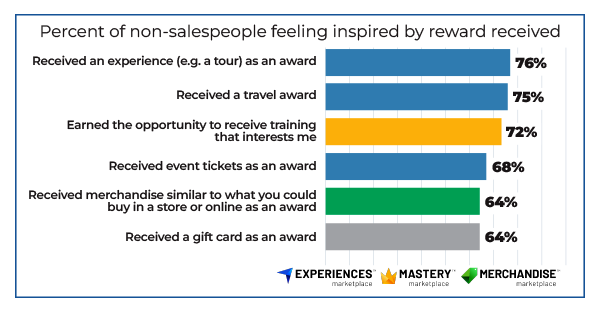
And the effect holds true for sales people, too.
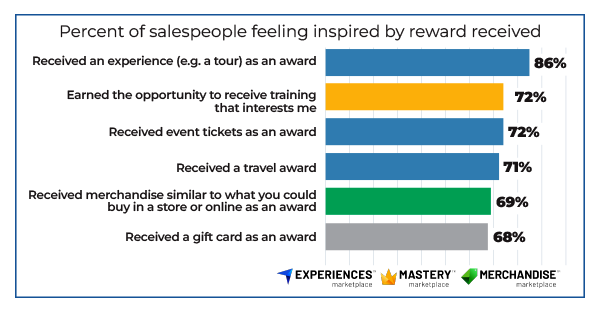
It’s not that cash doesn’t motivate; it’s that non-cash rewards create an emotional connection. They carry meaning, story, and memory: three things money rarely provides.
Evidence from the field
Our experience and our data consistently validate this finding.
Barry Danielson, Vice President of Decision Sciences at BI WORLDWIDE, has conducted multiple studies demonstrating the power of non-cash rewards.
“Numerous studies have shown that cash is not as effective in driving higher levels of performance as aspirational non-financial rewards such as merchandise, travel, and experiences.”
Across industries, non-cash rewards outperform cash in both engagement and long-term memory. People recall the trip, the experience, or the tangible item long after the check has been spent. That recall reinforces loyalty and performance.
Expanding the marketplace of motivation
Of course, not everyone wants a wooden bench. The secret lies in choice.
To inspire the widest range of employees, BI WORLDWIDE offers three diverse marketplaces filled with non-cash reward options. Our Merchandise Marketplace offers premium brands and top-tier items they’ll love. Our Experiences Marketplace helps send them on a trip of a lifetime with locations and experiences beyond their wildest dreams. And our Mastery Marketplace is filled with learning and development courses that get them excited about what they can accomplish.
When participants can choose something personal, it transforms a transaction into an experience.
The bottom line
Cash pays the bills. Experiences tell the story.
When companies balance monetary rewards with personalized, aspirational recognition, they don’t just compensate employees, they inspire them.
Give employees the opportunity to earn what they see as their wooden bench and watch performance soar.
Key takeaways:
- People claim to prefer cash but are more inspired by non-cash rewards.
- Non-cash rewards create emotional impact and long-term motivation.
- Research confirms that “preference reversal” drives stronger engagement.
- Choice amplifies meaning: the best rewards feel personal, not prescribed.
- Non-cash incentives like experiences and merchandise outperform cash across all roles.
Hear from our expert
Walter Ruckes, Vice President, Client Services
Business outcomes
Recognition that delivers results
“The strength of the team is each individual member. The strength of each member is the team.”
– Phil Jackson, legendary NBA coach
Phil Jackson built championship teams by developing each player’s unique strengths. The same principle applies in business: when leaders recognize and develop each employee’s contributions, the entire organization performs better.
At BI WORLDWIDE, our operational expertise and global research confirm that helping employees focus on key activities (and recognizing them for results) translates directly to measurable business outcomes.
Recognition: the multiplying effect
To understand how different types of recognition drive engagement, we asked our global panel which forms of recognition they received most often.
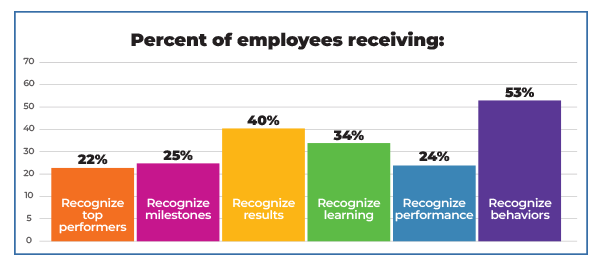
It wasn’t surprising that recognition for daily behaviors was the most common. These opportunities occur frequently and are easier for managers and peers to deliver in real time. Recognition for top performance and career milestones, on the other hand, was understandably less frequent.
But frequency isn’t the only story. We wanted to know if variety matters. Does receiving more types of recognition in a year lead to stronger engagement?
The data says yes, emphatically.
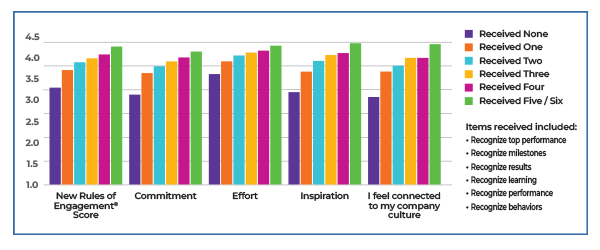
Employees who received multiple forms of recognition were significantly more engaged than those who received one or none. Bottom line: more recognition and more kinds of recognition create stronger engagement.
Recognizing results and performance: the winning combination
Next, we looked at the impact of recognizing performance and results compared to other types of recognition.
The pattern was clear. When employees are recognized specifically for achieving results or demonstrating performance excellence, their engagement levels climb higher than with any other recognition type.
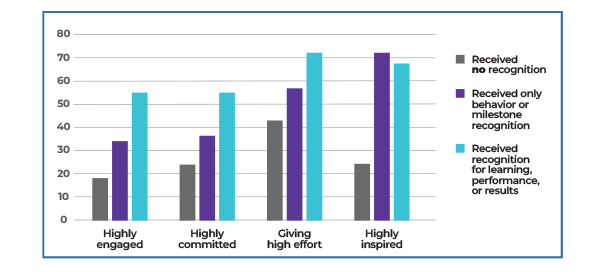
All forms of recognition boost engagement, commitment, and inspiration — but recognizing results and performance delivers the strongest return on investment.
From insights to ROI
Turning insights into business results requires deliberate design.
Barry Danielson, Vice President of Decision Sciences at BI WORLDWIDE, explains how our proprietary Impact Advisor tool helps organizations connect recognition to measurable outcomes:
“As we identify opportunities with customers, we use our Impact Advisor tool to focus conversations on key business challenges like turnover, productivity, safety, absenteeism, speed to competency, and model how enterprise-wide recognition programs can address them. We quantify potential improvements, forecast ROI, and track actual impact as the culture of recognition matures.”
Danielson notes that the business case is compelling:
“When a company has developed a recognition-rich culture, they can expect measurable gains across multiple outcomes: lower turnover, higher productivity, fewer safety incidents, reduced absenteeism, and greater customer loyalty. In one global manufacturing client, we observed a 49.3% higher retention rate among employees who received recognition compared to those who did not. When recognition included an award, retention increased by 64.7%.”
That’s not just engagement; it’s economics.
Translating recognition into business performance
How do these insights translate into measurable business success?
Christina Fortier, Solution Owner for PerformIQ® at BI WORLDWIDE, outlines four key benefits of recognition programs designed with results in mind:
1. The efficiency advantage
Efficiency isn’t luck; it’s focus. Balanced performance aligns teams, clarifies priorities, and keeps critical work front and center. Recognizing the behaviors that impact business results around that alignment drives engagement and motivation for frontline employees.
2. Clear expectations = better performance
Organizations that clearly link individual goals to strategy through balanced performance frameworks report measurable improvement. On average, more than half of their key performance indicators improve within the first few years of implementation.x
3. Misaligned frameworks reduce financial performance
When the metrics teams are measured on are not linked to strategic revenue or cost-savings goals, organizations incur hidden inefficiencies: duplicated effort, internal friction, lost opportunities. And that is a clear cost to business.
4. The revenue growth multiplier
Balanced performance doesn’t just track outcomes; it accelerates them. When goals, metrics, and recognition align, growth becomes predictable and scalable. Connecting KPIs to decisive action is how you impact your business. Data doesn’t drive growth. Employee decisions do.
A case study in recognition ROI
Fortier shared how BI WORLDWIDE partnered with a major telecommunications company to transform performance and engagement.
“We implemented the Five Star Performance Program to drive efficiency, service quality, and engagement across 60,000 associates. The program emphasized personal best goals, transparent performance tracking, and monthly, quarterly, and annual recognition for achieving Five Star status in key metrics like safety, efficiency, and customer satisfaction.”
The results? Extraordinary.
“Over eight years, the program generated $950 million in incremental revenue and $527 million in cost savings,” said Fortier. “Beyond financial results, it built a culture of accountability and continuous improvement, proof that recognition-based motivation can drive both engagement and operational performance.”
From insight to impact
Recognition is more than a feel-good exercise; it’s a performance multiplier.
When organizations recognize both performance and results, they don’t just build stronger teams. They build stronger businesses.
Coach Jackson would be proud: help each member of your team grow stronger, and the team becomes unstoppable.
Key takeaways:
- Recognition variety amplifies engagement.
- Recognition tied to performance and results yields the strongest ROI.
- BIW’s Impact Advisor and Perform IQ® tools link recognition directly to business outcomes.
- Recognition-rich cultures deliver quantifiable results: higher retention, productivity, and profitability.
- Balanced performance and recognition alignment create sustained business growth.
Hear from our expert
Christina Fortier, Solution Owner, PerformIQ®
Ideas that drive change
The Linus Pauling effect: how volume fuels innovation
Linus Pauling, the only person to win two unshared Nobel Prizes, was once asked how he generated so many breakthrough ideas. His answer was disarmingly simple:
“The best way to have a good idea is to have a lot of ideas.”
How ideas begin
Our global panel reveals that organizations cultivating learning, development, and support are also the ones igniting creativity.
Employees who feel their employer:
- Provides opportunities to develop skills are 7.7x more likely to say their workplace brings out their best ideas.
- Offers avenues to master important skills are 10x more likely also say their workplace brings out their best ideas.
- Ensures tools, resources, and support are available are 5.8x more likely to feel inspired to contribute their best ideas.
And when employees believe, “My ideas are taken seriously,” they’re not just happier – they’re transformational:
- 11.5x more likely to be highly engaged
- 7.4x more likely to be highly committed
- 5.2x more likely to give high effort
- 10.7x more likely to be highly inspired at work
Academia supports this. As one study puts it:
“A climate for innovation emerges when employees experience norms and practices that reward flexibility and idea expression. By empowering employees and encouraging learning, organizations stimulate them to take charge, adapt, and build on their ability to achieve the mission.”xi
Translation? Support creativity, and you’ll unleash it.
Turning insight into innovation
At BI WORLDWIDE, we’ve seen that innovation isn’t accidental; it’s behavioral. Our three-phase model helps organizations build repeatable systems for idea generation:
1. Know the challenge and gain insight into how each person can contribute.
2. Feel ownership and curiosity to explore potential solutions through collaboration and investigation.
3. Do what drives measurable impact by participating fully: share, refine, and implement ideas.
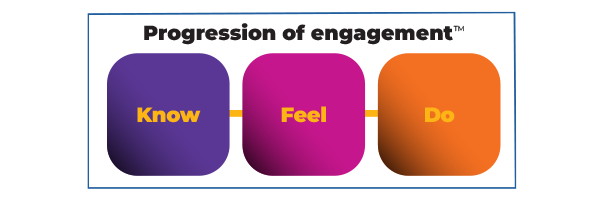
When organizations move through these stages with purpose, innovation becomes a habit, not a hope.
Ideas in action: Free Cash Flow Challenge
A great example comes from our partnership with a global medical device company, whose leadership embraced the power of many ideas.
In 2020, their chairman and CEO said he was pleased by the free cash flow generated. They had set a target to improve free cash flow conversion in three years and achieved it in just one year.
“I’m particularly pleased by our free cash flow generation. We set a target to improve free cash flow conversion to 80% over a 2–3-year period, and we achieved it in just one year! We delivered free cash flow of $5.9 billion in FY19, growing at a rate of 62%. This reflects the focus of our entire organization and includes the impact of initiatives such as the Free Cash Flow Challenge.”
Steven Mars, Solution Owner for Financial Solutions at BI WORLDWIDE, explains:
“The Free Cash Flow Challenge and Ideas solutions both activate the power of people — your employees. One drives operational efficiency, cost optimization, and revenue growth. The other empowers employees to surface innovative, bottom-up savings, and revenue ideas. Together, they unlock measurable financial impact and foster a culture of ownership, innovation, and recognition.”
At its core, the model rewards employees for actions, behaviors, and achievements that generate specific results aligned with company goals.
Why it matters
The formula for innovation isn’t mysterious; it’s measurable.
Organizations that provide opportunities to learn, empower employees to experiment, and take their ideas seriously don’t just get more ideas. They get better ideas and more engaged people behind them.
Want more innovation? Start by inspiring more ideas.
Key takeaways:
- Innovation thrives where learning and empowerment intersect.
- Employees whose ideas are taken seriously show 10x higher engagement and inspiration.
- A structured model like Know, Feel, Do builds innovation momentum.
- The Free Cash Flow Challenge shows measurable business impact, not just tenure.
- The “Linus Pauling Effect” proves that the path to one brilliant idea begins with a hundred small ones.
Hear from our expert
Steven Mars, Solution Owner, Financial Solutions
Communication breakdown
Is “TMI Syndrome” disengaging your sales force?
Information is power until it isn’t. For many sales organizations, communication has become a flood. Too much, too scattered, too impersonal. Our global research shows that “TMI Syndrome” (too much information) is one of the biggest engagement killers in sales today.
Below are the six most common communication challenges identified by our panel, paired with proven strategies to solve them.
1. Misaligned strategy and priorities
When sales teams don’t understand the bigger picture, engagement crumbles. Employees who believe leadership has a compelling vision are 13.2x more likely to be highly engaged. Yet 70% of sales employees say they receive conflicting messages from their employer.
Fix it: Align every communication to clear goals.
Employees who say leadership communicates clearly and concisely are 9.6x more likely to be engaged. Use personalized, data-driven scorecards to track goal progress and tie communications directly to performance.
“We recommend implementing personalized, visual, and data-driven scorecards that are updated bi-weekly or monthly. This provides tangible evidence of progress which fuels motivation. When paired with targeted nudge content, they sustain engagement and reinforce behaviors that drive results.”
– Matt Givand, VP of Communications, BI WORLDWIDE
2. Information overload or underload
26% of salespeople say they receive communication too frequently, while others say they receive none at all. 63% report feeling overwhelmed by information, higher than the 58% reported by non-sales employees.
Fix it: Cut the clutter.
Streamline communications through curated enablement platforms and brief, purposeful updates. Meet salespeople where they already are in the tools and channels they actually use.
“When we aligned communications with existing channels for a large commercial sales organization, participation skyrocketed.”
– BI WORLDWIDE + ProHabits Partnership
3. Lack of feedback loops
Top-down communication is a one-way street, and it kills engagement. Employees who feel their ideas are taken seriously are:
- 11.5x more likely to be highly engaged.
- 7.4x more likely to be committed.
- 10.7x more likely to be inspired.
Yet 40% of sales employees say leaders don’t understand the typical employee.
Fix it: Build structured feedback systems like listening sessions, pulse surveys, and CRM insight reviews.
“An intentional employee listening strategy helps you confirm or dispel what you thought you knew, leveraging actionable data to drive improvement.”
– Quantum Workplaceii
And remember: when managers provide honest, constructive feedback, employees are 9.1x more likely to be highly engaged and 9x more likely to be inspired.
4. Inconsistent messaging across teams
When teams interpret leadership messages differently, culture fractures. Employees who experience strong teamwork are:
- 10x more likely to be engaged.
- 8.9x more likely to be inspired.
Fix it: Standardize internal playbooks and communication guidelines.
Consistent, repeatable messaging across all channels ensures teams tell the same story to customers and to each other.
5. Emotional disconnect
Sales is a pressure cooker. When leadership communication feels cold or corporate, it erodes trust. Employees who trust leadership are 11.9x more likely to be engaged and 10.9x more likely to be inspired.
Fix it: Lead with authenticity.
Empathetic, transparent communication builds trust, especially in tough times. When employees hear honesty from leaders, they’re 8.3x more likely to feel inspired.
And never underestimate the power of recognition. When employees hear “You did a great job,” they’re 8.7x more likely to be highly engaged and 7.7x more likely to feel inspired.
6. Poor use of communication channels
Over-reliance on email or static meetings leaves messages lost in translation.
Fix it: Match the medium to the message.
Use short videos, Slack updates, and rich-media messages to keep salespeople informed in real time.
“Modern communications tech, such as BIW’s Actify platform, enables us to deliver highly personalized content tailored to each salesperson or employee. By leveraging goal progress, activity levels, and even sentiment, we ensure that messages are not only timely but also contextually relevant. These content nudges can be deployed across a client’s preferred channels, usually email or rich-media SMS, creating a more engaging and personalized communication experience.”
– Matt Givand, VP of Communications, BI WORLDWIDE
An interview focused on behavioral science and the human element
Dr. Kurt Nelson, behavioral strategist and long-time BI WORLDWIDE partner, has worked with global sales organizations to make communication more effective and more human. We asked him his thoughts on the challenges of communication with salespeople.
Here’s a summary of that interview.
Q: In your work with sales organizations and their compensation plans for sellers, what are you seeing as the major challenges?
Many of the organizations we work with struggle to ensure that sales representatives truly buy into the goals that are allocated to them. We find a recurring disconnect: salespeople often perceive their goals as unfair, inaccurate, or out of reach. When goals are not seen as both achievable and fair, salespeople lose trust in their incentive compensation plan, decreasing motivation and performance.
Another significant challenge is balancing a “pay-for-performance” philosophy with the reality that sales results are influenced by many factors outside of an individual’s control such as market shifts, pricing decisions, access constraints, or territory dynamics. This ongoing tension sparks debate around whether, and to what degree, incentive plans should include a “safety net,” such as a minimum earnings floor. Too little protection risks disengagement and burnout, while too much can dilute the motivational impact of pay-for-performance models.
One last challenge that we are witnessing is the rise in uncertainty, felt both at the leadership level and among front-line employees. Leaders are navigating shifting economic conditions, regulatory changes, and unpredictable market dynamics that are more chaotic than ever. Meanwhile, employees are not only impacted by these external forces but are also grappling with how the organization responds. For many, this translates into concerns about job stability and future prospects. This uncertainty drives increased stress, burnout, and a sense of languishing that is higher than we’ve seen in years past.
Q: How can behavioral sciences help with these challenges?
Understanding how the brain processes goals and the emotional impact those goals can have helps companies to communicate them in a more effective manner. Behavioral science research on goal setting and fairness shows that people are more motivated when goals are framed as challenging yet attainable, and when the process of how those goals are set is transparent.
This means that companies should not only focus on what the targets are, but also how they are explained. Clear communication, with a rationale for why goals are structured a certain way, builds trust even if the salesperson doesn’t “like” the number. Goals presented in a way that emphasizes progress, mastery, and opportunity trigger very different motivational responses than goals presented as punitive quotas. The way leaders tell the story of a plan by using concrete milestones, visual aids, and examples of past success changes how salespeople see the goals and thus respond to them.
Insights from loss aversion and psychological safety help organizations navigate the safety net debate. Humans are more sensitive to losses than equivalent gains, which means that plans designed with too much downside risk can drive fear rather than performance. At the same time, a modest earnings floor can preserve psychological safety, ensuring that salespeople stay engaged and willing to take smart risks instead of playing it safe.
Finally, behavioral science provides insights into how people deal with uncertainty and stress. We can provide behaviorally based tools and training for leaders to help their team (as well as themselves) handle and respond to this uncertainty in a way that reduces stress and anxiety.
Q: How have business outcomes been impacted as a result of your work?
Our communication work around incentive plans has improved how well the field understands their IC plans as well as the perception of those plans. We have seen understanding increase in some instances over 40% and overall satisfaction with a plan increase up to 15%. Those changes in understanding and perception lead to improved motivation and performance.
Q: Anything else you would like to add?
While uncertainty has always been a component in any business, the levels that we are hearing and the subsequent anxiety we’ve seen over the past year have skyrocketed. The impact that this will have on organizations is still being played out, but we feel that it will be significant.
When communication is clear, authentic, and continuous, it builds trust, drives performance, and keeps sales teams focused on what matters.
Key takeaways:
- Misalignment and TMI are silent performance killers.
- Personalization, clarity, and feedback loops transform communication from noise to impact.
- Recognition and authenticity humanize leadership messages.
- Applying behavioral science to sales communications improves understanding, motivation, and trust.
Hear from our expert
Ben Drake, Creative Director, Communications
Conclusion
From insight to impact
We set out to uncover the truth about what engages people at work. Along the way, we’ve learned that engagement isn’t a program; it’s a promise. A promise that when people bring their best to work, their organization will meet them halfway.
This year’s findings reaffirm that the fundamentals still matter: recognition, feedback, purpose, and belonging. But they also reveal a deeper truth: engagement evolves as the world does. AI, hybrid work, and shifting expectations haven’t changed what people need. They’ve simply made clarity, authenticity, and trust more urgent.
The data is clear:
- When employees feel seen, they give more.
- When they feel heard, they stay longer.
- When they feel valued, they create impact that can’t be replicated.
Facts matter.
But what we do with them matters more.
Appendix
BI WORLDWIDE partnered with a United States panel company and the panel company’s global partners to target English-speaking employees of companies with 1,000 employees or more.
After completing data quality procedures, a total of 2,192 surveys were included with 1,088 of those being U.S. surveys and 1,104 being non-U.S. surveys. A total of 18 countries on five continents were represented in the surveys from twenty industries, including healthcare, consumer goods and services, technology, and finance.
The data from the United States were balanced to reflect the age, gender, and ethnicity of full-time U.S. employees as outlined by the Bureau of Labor Statistics. Forty-seven percent of respondents were female while 53% were male. The average respondent age in the U.S. was 42.5 years with a standard deviation of 14.1 years.
The data from non-U.S. respondents were similar, with 39% of respondents being female and 61% being male. The average age of respondents outside the United States was 37.2 with a standard deviation of 11.7 years.
Additional sources
i Christakis, N. & Fowler, J. (2011). Connected: The surprising power of our social networks and how they shape our lives. Back Bay Books.
ii Ryba, K. (2025). What is performance management? Building a strategic performance management process. Quantum Workplace.
iii Pacheco, R. (2025). Why feedback can make work more meaningful. Harvard Business Review.
iv Ernst, C. (2025). Transparency triumphs: Why openness is key to unlocking talent success. Workday.
v 25+ powerful AI quotes from leaders of top companies about the future of AI and automation. (2024). Digityze Solutions.
vi 25+ powerful AI quotes from leaders of top companies about the future of AI and automation. (2024). Digityze Solutions.
vii Automotive Service Technicians and Mechanics. (2025). U.S. Bureau of Labor Statistics.
viii Cutting the clutter to reduce turnover. (2024). BI WORLDWIDE.
ix Shaffer, V. A. & Arkes, H.R. (2009). Preference reversals in evaluations of cash versus non-cash incentives. Journal of Economic Psychology.
x Kaplan, R. S., & Norton, D. P. (1992). The balanced scorecard—measures that drive performance. Harvard Business Review.
xi Park, S. & Park, S. (2019). Employee Adaptive Performance and Its Antecedents: Review and Synthesis. Human Resource Development Review.
xii Ryba, K. (2025). Building your employee listening strategy: a framework to move you forward. Quantum Workplace.