
Why cash incentives underperform
(Even when sellers prefer them)
Most sales leaders already know how the reward conversation goes: ask sellers what they want—they say they want cash. End of discussion.
It feels efficient, practical, and aligned with the voice of the field. It also points many incentive programs in the wrong direction.
Cash—and cash equivalents like gift cards—are often treated as the obvious choice because they’re flexible, familiar, and easy to defend. But the job of an incentive reward is to change behavior, increase effort, and lift results, not win a preference poll.
Behavior, effort, and results are different tests, and in this study, cash failed.
When preference and performance diverge
An insurance company tested this assumption directly. BI WORLDWIDE conducted a study over a three-month period where 1,263 independent agents participated in a controlled incentive program:
• The first group earned a $50 gift card for each policy sold.
• The second group earned $50 worth of points per policy with no visible dollar value.
• Rewards were distributed monthly.
If stated preference were a reliable predictor of performance, the gift card group should have led.
It didn’t.
The points group more than doubled the sales rate of the gift card group, reaching 212% of their performance. But the more important story is how that performance gap was created.
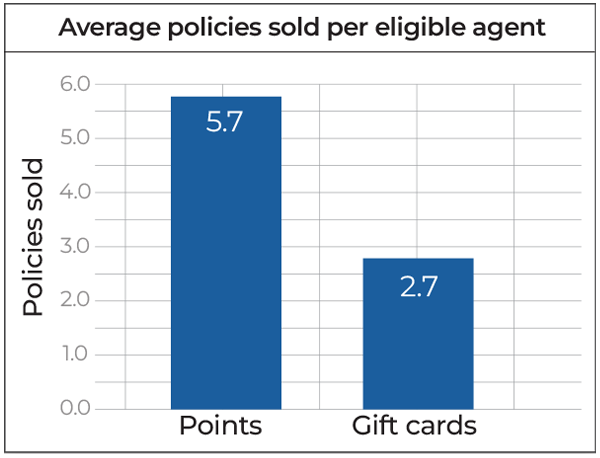
More sellers engaged. More sellers produced.
The points-based designed not only drove output but also changed participation.
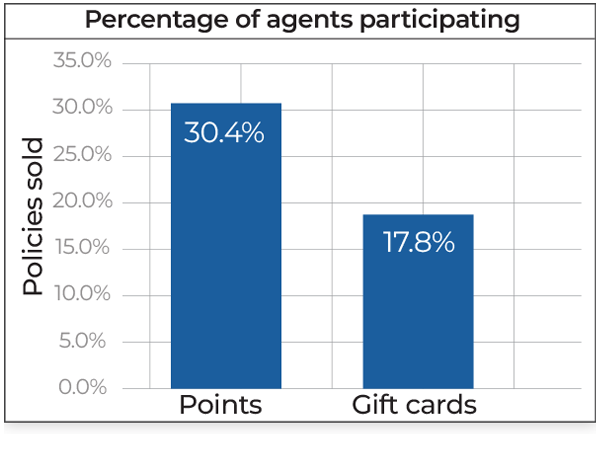
52.3% more agents participated in the points program than in the gift card program. Among those who did participate, agents in the points group sold 22.1% more policies. That combination matters.
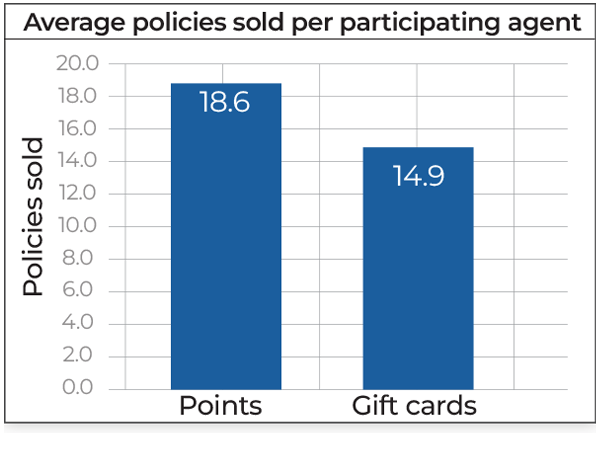
This was a system-wide shift. More of the field chose to engage, and those who engaged delivered more. That’s what turned a reward choice into a measurable performance gap.
The mistake many teams still make
Despite results like these, many organizations continue to design incentives around a simple assumption: if sellers prefer cash, cash must motivate best.
It’s a straight-forward idea. But it’s also wrong.
Stated preference reflects how people think as consumers, focused on flexibility, bills, and convenience. Incentives operate in a different arena entirely. They compete for attention, attach emotion to effort, and shape what people remember, talk about, and pursue.
On those dimensions, cash is often at a disadvantage.
Why non-cash rewards outperform
The research points to three structural advantages that help explain the difference.
1. Memorability
Cash disappears into everyday spending. Experiences, merchandise, and aspirational rewards stay visible. They create a mental target that keeps the incentive top of mind.
2. Emotional re-consumption
Non-cash rewards are experienced more than once. People revisit them when they use them, share them, or talk about them. That extends the motivational impact beyond the moment of earning.
3. Tangible goals
Points-based systems make progress visible. They turn effort into something trackable and buildable, helping participants see what they are working toward and how close they are to getting there.
None of these advantages show up in a preference survey. But all of them show up in performance.
Reward design is a performance lever
This is where the conversation needs to shift. Too many incentive programs are built around what is easiest to explain or defend. Cash feels simple in a budget meeting, safe in a plan document, and aligned with the field. But safe is not the same as effective.
If your objective is to move a sales force, reward design needs to be a performance lever and not an administrative decision. Choosing cash out of convenience is a costly mistake.
A better question for sales leaders
Sales leaders don’t need to eliminate cash entirely, but they do need to stop giving it automatic status as the best answer. The right question isn’t “What reward do participants say they prefer?” The right question is “What reward structure gets more of the field to engage, stretch, and deliver more?”
In this study, the answer is clear. Cash didn’t fail because it lacks value. It fell short because it lacks impact on behavior, which is where it matters most. That leaves one decision: keep trying to optimize based on seller preference or start designing for performance.